When Someone Else Saves The Day

We are conditioned for everything it seems, and expecting someone else to save the day is one of them, perhaps. We even have a saying ‘a knight in shining armour’ to save you. I never liked that idea, just sitting around and waiting for a hero to swoop in and save the day, whether it be a knight or a maiden. Of course, we like it in movies, it’s predictable and safe, and usually leads to a happy or at least satisfying ending. But what of those stories and the ones in particular I have selected for my usual rundown.

Robin Hood – I would consider this known by most, so goes top of the list. The classic tale of wrongdoing and justice for the people, in the most peasant revoltish kind of way possible. And they won. So we are told that he was a myth, a legend and these days maybe just a money maker.

William Wallace (Braveheart) – again, we are led to believe there was someone so passionate about their beliefs, countrymen and way of life, they managed to rally an army of followers, but ultimately failed. That’s the kind of hero they want you to see, the one who sacrifices themselves, and still loses.

Boudicca – One of our rare female heroes in history that apparently rose up and fought back, only to then be killed, of course.

Guy Fawkes – Another famous one that has been allowed to persist in its telling and in fact commemorated each year still to this day, the same tale over and over. So close, but they too failed.

Those are all apparently real people (maybe not Robin Hood), from our past on this small Island, but the fact we have stories like that leads me to two conclusions.

a) These people did exist and overthrew what was then in place, but after victory time passed and although their names persisted, the stories could be re-written to show they didn’t win. Couldn’t have the peasants getting above their station and believing in themselves.

b) Or they are part truths or perhaps completely fabricated stories to try to instil in our collective psyche that we will always lose if we fight back. Either conclusion ultimately gives the same result.

So I ask myself, what advantage would that give the programmers? Having a people not believing in their own collective power and what they are capable of could be a handy tool if you wanted to hold people down, and decide what they are allowed to know. Knowledge is power as they say.

There are also a number of films, even though many films have been made of most of the above, and there will be countless others I don’t mention.

Terminator Films (John Conner) – The central character of these films being the one to save the day and bring an end to the turmoil.

Poseidon Adventure (The Preacher) – I have only watched the 1972 film for this, but thought it was great. Someone trying so hard to save people, showing courage in the face of adversity, only to die at the end himself, but he did save some. It wasn’t all for nothing in the end.

And there are other movies, where we are led to believe that there is only one who can save everyone. The One.

The Matrix – Neo

Star Wars – Luke Skywalker

Harry Potter – Harry Potter

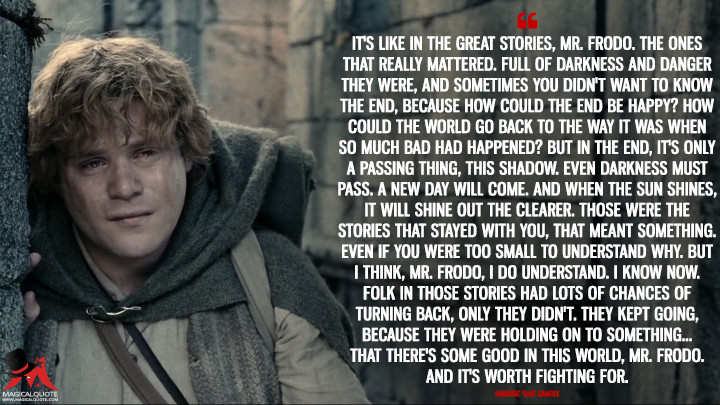
Lord of the Rings – Frodo, but Tolkien did a switch there, because Frodo wasn’t the one or the hero after all, he failed, and Sam was the hero, not because he was chosen, but because came through when it was needed most.

But in all those films, they didn’t just do it by themselves, they had friends and something to fight for. And it may sound as corny as the films do sometimes, but love, friendship and what is right in this world is worth fighting for and believing in.

From The Two Towers (internet source: magicalquote).

(c) K Wicks

Cruelty

It’s not a nice thing to know your fellow man (and woman) are capable of such stark levels of cruelty towards each other and other sentient creatures. I have read a few news stories lately which reminded me of a feeling I carried for much of my life, a bewilderment I guess that people who walked and talked like me, could do such awful things. I read about lots of grisly things when i was young and growing up, but two incidents stayed with me in particular, both within a couple of years of each other. I was 12 when James Bulger was killed, and was more than horrified by this terrible atrocity. It was perpetrated by kids, only a year or two younger than myself and I was shocked being honest. I didn’t know it could happen like that, I thought us kids were the ones who had to be frightened of adults, not other kids. It changed my view somewhat of my peers at the time. My mother was equally horrified and it was no accident I had read all the serial killer books in our house, they were hers. But I didn’t know of another tale of the past, another equally shocking event. Mary Bell. If you haven’t heard of her, look her up, but the thoughts should not be with her, they should be with her two young victims and their families. She has been released with a new identity just as with the 1993 killers. Odd isn’t it, that we would go to such lengths to give new lives to the coldest and disturbed in our society, and then let them back out to ‘integrate’.

The other incident in the news, was Fred West. It was shocking, and there have been others as you well know, but those two within a short time hit home that we aren’t all like each other, and people’s motives can be very dark and twisted indeed.

There have been many recent stories that have reminded me of the cold heart some humans have (or lack of heart completely), but two got me thinking again about the senselessness of it all. A poor boy murdered by his parents and dumped in a river. A young man almost starved to death after being locked away in an attic by his parents. Such a personal level of cruelty, up close and very personal, family in fact. So is it really so hard to believe that if people can be that cruel to family and ‘loved ones’, they could be equally so to others. What are they capable of towards strangers?

And what of the ones who were like those children, but maybe never got caught, had some self-control or restraint, and then grew up to be the adult version of that. The ones who perhaps understood that you can still torture people and ruin them without ending their life, but just by making it miserable. And when they see you are distressed and harmed (emotionally or physically), it makes them happy as that is their purpose. I do suspect that those are the type of people now in charge of the behaviour unit and the government, and that those type of people have infiltrated most levels of society where you have a middle-man service. I touched upon that briefly in my article It Looked Sinister, because I had already realised we are being dictated to by some very cold and heartless people. And they usually want to have power over people, in some capacity. So, I will always look at those who make their way into positions of power, whether it be law enforcement and justice, teaching, medicine, entertainment, business and any other walk of like where they ‘need’ to be around people. And it’s a tough one, because alongside those people are the complete opposite, the ones who do care, and want to help and make sure others flourish and bring a bit of good into others’ lives. So, what do we do? They look the same, wear the same uniform and say the same things – how do we know? And that is the big one isn’t it – how do we know who is a good person and who is a bad person? We don’t, because it’s not that simple. Good and bad is a bit of simplification of what goes on internally and emotionally, so to paint it a simple thing is misleading to the thought process I feel needs to be engaged for it.

Let’s look at it in a more basic and helpful way. Not whether they are good or bad, but does this person mean me harm? And that could be any harm, physical, emotional, financial, whatever is it. Take away the good and bad, as they can confuse the problem. How many times have people got away with things because they ‘seem like a good person’ or appeared to be as such. Or someone was damned because they were a ‘bad person’ to either you or someone else. Notable, but ultimately irrelevant. Because we all know that someone can be an arse to someone else, but not to us, so we shouldn’t judge people on that, but we do. Sometimes people make lots of excuses for wrongdoing because they were a ‘good person’ and they get away with it, and just so, people are judged harshly whatever they do, because they have been judged to be a ‘bad person’.

We should really be assessing whether someone means us harm and what they are motivated by. And re-assessing it again, and again, and again as necessary. Because people change, as do their motives and intentions and sometimes circumstances, and the moment you realise their intention has changed to a harmful one or one of hinderance towards you, it must be addressed. Acceptance can save people an awful lot of hassle in their life, just accepting it is what it is. That doesn’t mean you have to be demoralised by it, in fact it can be quite the opposite and motivating for you to move forward. We are the change we are looking for…

(c) K Wicks

Mass Psychosis or Run Around?

With the suggestion of there being a mass psychosis going on, and talk of why so many people have ended up following the crowd, I decided to give it new thought given the new subject matter now at hand. Both things seem to be part of the same process in my mind, and something mentioned at the beginning of this debacle reminded of it.

A TV show from 70/80’s called Run Around. I vaguely remember it mentioned later, but was more of an 80/90’s kid. Anyway, premise is a group of kids, a question with 3 options for a correct answer and you pick a circle to go in with what you think is the right answer. Timed of course. And predictably people would dither and be swayed by the majority and go with that. Before the time was up, you could switch if you thought you knew better.

The naming is apt here because we have been given the run around, and there was no right answer to be had. Yet they had everyone scrabbling to know something, made it seemed timed, and inevitably people switched sides and second guessed themselves. Well, some people did.

So, is this a case of people being deluded and in a trance from the propaganda and careful planning by the behavioural unit? Or is it just confusion and they picked the wrong circle to stand in. And rather than it being a timer which determines the answer, it’s your own ego and pride that need to decide and can go on for a long time. Here I guess is where the ability to know something is up and admitting it is a really useful skill. But what of the other group, the ones who do know something is up, and actually just don’t care? People may have just been worn down by the ‘modern life’ they have already inflicted on people, who can say for sure, but I may speculate on that one further.

(c) K Wicks

Times Are Changing

There have been two articles around this subject already, discussing what seems to be here and what may be coming our way –

A piece at a time

Monitoring

An overview of things as I have observed them, taking into account small areas of concern which appear to be part of the bigger picture. Of which not everyone seems to be bothered by, but I wonder if they are unable to consider the consequences of where it leads. There is an article around that as well if interested.

Forethought and Consequences

But this one is to speculate on the things that are here now and approaching. The things that have been openly discussed, reported and seem to be coming our way whether we want them or not.

Social credit score system – do as they say or you will be punished

No car ownership – limits your travel options and ability to mobilise

Regulations on heating and food – keep you cold and hungry

End of life care – they get to decide if you are ‘past your prime’ by their standard

Drone surveillance – to watch and restrict what you do and where you go

Digital Currency – so they can monitor your money, and then ultimately control it for you

All of this is being swept in under the initial guise of a ‘pandemic’ and is neatly intertwined with their ‘climate change’ agenda. How convenient. But make no mistake, it is a complete overreach and is beyond anything I genuinely thought I would see in my lifetime. Yet, here we are, witnessing what can only be described as a takeover. Of our lives and our future. An interference on a whole new level that some are unable to fathom, are unwilling to see or worst still, are on board with the new regime.

It appears they are not content with disrupting everyone’s current life, causing issue and instability for families, friends, workplaces and taking over leisure, education, religion, travel and more. They want to go further. It appears to be a very sterile, controlled, joyless environment and society that is on the cards. Minimal contact with others, information only provided by authorised groups, your choices made for you, experiences controlled and restricted as with everything else. How more people aren’t concerned by that is a concern by itself. The reaction has not been proportionate to the event, at all.

Finally though, some people are showing the level of public concern we need to see in an organised and calm way. Canada. Also this shows me very clearly why they might like to take away vehicles from people, or make them electric, or add a kill switch. Very sure way to eliminate anything like this in the future. It does appear to be escalating though as the people in charge are starting to appear anything but calm. As if they are on the clock or something.

We also have a distraction and money maker looming with war being talked about, again. It’s hard to keep up with their created doom sometimes, there has been so much throughout my life already, but manufactured doom isn’t the same as an unforeseen event. We hear much talk of things being reset, and it has made me think of all the other events throughout history. The ones they chose to glorify and put the prefix of Great in front of it. When you start to really look at their version of the past, and how cleverly they fooled everyone into thinking it was true, you can see why they might think the future is in the bag.

As the old saying goes “whoever controls the past, controls the future”, and there are many other sayings, old wives tales and myths that should be reviewed and looked at from a different viewpoint. All is not as it seems.

(c) K Wicks

Hyperphantasia and horror

This is one of my articles about Aphantasia and Hyperphantasia, and although it’s not the only thing influencing what people are into and whether they enjoy horror, it appears to be a big factor in the difference between myself and my husband and our interests (or lack thereof), in fiction and in particular, horror.

My other article Fiction is Pointless describes how we stumbled upon the difference and what it led to. But I speculate further into the area of horror fiction because I find it interesting and wonder whether it might help other people understand some of the mechanisms going on in mind which shape us. Personally, I had nightmares as a kid and was afraid of things I couldn’t see as well as the things I could. I was probably traumatized by films like any other kid, or so I thought, and watched a fair amount of horror where I could growing up in the 80’s – a time when censorship was moving through and they became sought after and a right of passage for a time.

I kept a lot of my fears to myself, just going through them quietly and possibly just presuming lots of people would be affected in the same way. Another article Hyperphantasia, a down side went into a more detailed look at one film in particular that chose to feature and repeat for me as a recurring issue, and one I couldn’t hide, so it became a family joke that I was scared of sharks. You may have guessed from that which film I’m talking about.

So when we discovered the difference that one of us doesn’t visualise in mind (Aphantasia), and one of us does (Hyperphantasia), I mentally went through it and imagined being someone without pictures in mind, without an internal monolgue or any kind of replay going on. Speculating on how that might affect my interactions, thought processes and general day to day life. The differences were massive, and maybe I shouldn’t have analysed it so much but it’s what I do, so no stone was left unturned as you might say. Then I wrote an entire book on it, steering away temporarily from my fictional writing to write my first non fiction book (link below).

I asked only a few questions to delve into the effect horror films may have had on someone with Aphantasia.

Q: So you have never had a nightmare?

A: No

Q: Were you ever afraid of the dark?

A: Why would I be afraid of the dark?

Q: Did the concept of anything or the tension in a film scare you?

A: Why would I be scared of something I can’t see?

There didn’t seem to be the need for many more questions on that, it was a logical response that summed it up perfectly. I won’t lie though, I was pretty shocked to know some people were like that, and more to the point, that I wasn’t. It’s taken me decades to manage my thoughts, the visualising and replay mechanisms without knowing what they were or why they were there. And once I did, it turned out I had been trying to understand them while also at the same time feeding them. I wish I had know many years ago about Hyperphantasia because I would have known to better filter my input, or understand sooner that what I read or watch, will stay with me, wanted or not.

There is still much to understand about what our brains are up to and how they may help or hinder us along the way, so the research continues…

(c) K Wicks

What is going on?

This one is about the people. Not ‘We the People’ – that would mean we were together on this. But we are not, a very distinct divide has emerged and not by accident. I have seen the word sociopath attached to the ones who are pushing for exclusions, separations, detention and even being denied life saving treatment for ‘non-compliant’ people. And having looked up the definition to be sure, they may be right with that assessment.

“Those with ASPD (anti-social personality disorder) have no regard for others’ rights or feelings, lack empathy and remorse for wrongdoings, and have the need to exploit and manipulate others for personal gain. Nature and nurture play a role”

All of that fits an awful lot of people right now.

No regards for rights or feelings. Previously we had a clear view on what rights were and that you had the right to not be interferred with, either your private life or your body if you weren’t doing any harm to anyone. For some reason people are extremely quick to put that to one side. And when it comes to feelings, I think that’s part of the problem. Feelings are being put above rights, mainly a feeling of fear to be specific.

Lack empathy or care for wrongdoings. Weirdly, people appear to be overlooking massive wrongdoings in the establishment and trying to focus on perceived ones seeming from the ‘feelings’ created by the propaganda machine. I wonder if it is just because people can’t face the reality of what is really there and going on. If you lack empathy though, you won’t be able to feel what others feel, and you won’t want to, because your feelings are more important than theirs, regardless.

The need to exploit and manipulate others for personal gain. This can be as basic as wanting to appear better than someone else, showing your allegiance to the cause by publically denouncing or humilating others because they don’t ‘conform’ to the group view. Or can be with a much more sinister motive and purpose depending on the person and their position in society. Opportunists are not new and will step up when the situation arises, where we find ourselves now is no exception.

Nature and nurture play a role. Well, that can be said of anything, but these times and odd happenings of late have been well nurtured. And some will have been of this way by nature, but never had an outlet or opportunity for it to ‘flourish’ shall we say.

I’m sure there will be much to mull over and dissect with regard to peoples behaviour in the present and coming times. And so far, it isn’t looking pretty or stable, but as they had a whole team of ‘behaviourists’ planning their project fear, I can only presume this was an intended consequence. Hopefully one we can recover from collectively.

(c) K Wicks

Forethought and Consequences – a follow up

This is a follow up from my previous piece Forethought & Consequences, which was from the angle of Hyperphantasia and Aphantasia. I now find myself giving it thought again since we the many, find ourselves being dictated to by the few, in a rather haphazard way. And there are two ways to look at it – incompetence, meaning they have no idea what they are doing and have no concern for what happens after. Or they are severely corrupt and are well aware of what will occur and what that might be.

I really did believe until a few years ago that everyone could think things through properly, especially people in a decision-making role. I have been grossly mistaken. Not everyone does in fact have the ability to plan out future scenarios mentally, or even acknowledge or understand the forethought that goes into them and the consequences that are considered along the way. This was proven to me way before this recent episode unfolded, and what often may have been overlooked as being careless or thoughtless behaviour, could in fact just be ignorance or inability to see the outcome of their actions. They really didn’t think ahead to what may occur from their words or actions, because they can’t and therefore don’t foresee that as a possible outcome.

And this is where it seems that the people in charge of presenting information and making decisions are lacking in this ability. I have been using predictive modelling my entire life, but the human version, which uses your brain and factors in variables as necessary and can adapt to new information, upgrade and revise the data as needed to predict the range of possible outcomes. And as part of the data yourself, you are able to change the outcome if so desired. As I understand it, we are using computer modelling programs to construct our society currently and basing important regulations on it which affect people’s lives. It would appear to me that we are running a much slower version of that, where a human has invented a program to model in the same way – but will only be as good as it’s programmer and the data it has access to. And cannot ‘think on its feet’ or factor in anything new without it being input from the human. That’s where we have the problem, clearly for all to see, which this isn’t a theory, it has been proven time and time again, the computer models and those behind them have been wrong. And those with a faster, more competent in-built modelling system are having to just sit and painfully watch the slowness at which we now operate. Surely, we could be utilising these inventions in a more effective manner if we are to be at the whim of them?

But on a more interactive level, people’s inability to view the consequences of decisions being made around them and for them is alarming. It’s more than a lack of vision and imagination, it’s as if general reasoning is also missing. So I have to question, was it there to begin with? Is there a certain amount of life you can indeed go through without requiring the need to think things through or consider what will come of it? When people say they are disappointed to see so many complying and not caring about their freedom and future being taken away, is it perhaps their expectation of people was misplaced? We just presumed people cared, or thought things through, or were able to reason and until faced with something to expose those differences, we didn’t see them. But it turns out they are very important in the bigger scheme of things. Nearly all of the consequences I saw coming have unfolded already, so I will definitely continue to follow my own thoughts in this and try and stay on top of the strange things that appear to be coming for 2022…

(c) MKW Publishing

Separate Realities

Never has it been more obvious that we aren’t all taking part in the same reality. I had always thought we had two realities co-existing within each of us anyway, our own personal one, and what I have referred to as a shared reality. The construct of society we all take part in together. But the shared version appears to under quite a bit of pressure and is unsustainable. Split and fractured into multiple ones converging and overlaying. Reality is what you make it they say, what you believe, what you see. But is it?

I have covered this as a chapter in my book Meeting in the Middle of Nowhere, from the angle of being able to imagine in visuals or not. And have previously tried to explain within that to someone who has Aphantasia, how other people are imagining a whole host of things in mind. Causing a separation from what is going on externally. To someone who has no internal monologue, or visual imaginings, it sounded like a very foreign concept.

But right now in society, there is a serious level of separation and divide between what people believe to be reality. And not by accident. It has been encouraged and engineered to be that way. Incorrect data and ever-changing parameters, misinformation on the part of the establishment and press, and people’s own fears used against them. All of that seems to have created a very murky set of ‘facts’ for people to work with. If you weren’t paying attention before this and didn’t instinctually know something was up, surely an alarm has been tripped in your brain by now? Apparently not for many people, or if it has, they are keeping it to themselves.

Many people have lost all perspective of what is a real threat, and how to respond or behave. I personally had someone online tell me it was ‘people like me who killed their loved one’. I corrected them instantly of course, that I had in fact been working from home all the way through and barely gone out, and that they were projecting their perceived fear in the wrong direction. But that is what some people feel the need to say, and made much easier from the comfort of being behind a screen without having to deal with the debate or truth of what they are missing.

But that is their reality i realised, they have formed a belief system around some partial facts. They seem to be awfully disturbed when you might try to introduce some new information or ask them to consider an alternative view. Oddly so. I have decided they either lack the capacity to assimilate new information, or can’t think on their feet to be able to adapt and ‘upgrade’ their thought process. They remain stuck in their version of reality. Which works to a point, until it encounters a different one, or one that would disrupt their own.

Some people now believe that their fellow human is a walking biohazard. That they should be afraid of them, keep them at a distance, to worry about touching them. For no good reason. It’s cruel what they have done to people. Life was hard enough for some and already a struggle without all the relentless fear, doom, pressure and changes being implemented and threatened.

We need a shared reality that works, and some coherent talks about how that can be achieved. But while manipulated fear is leading the way its going to be very difficult to find a clear path. I get the feeling they are not done with their grand deceptions, so it will remain to be seen if we are ‘allowed’ to stabilise and find our feet. Stay sharp and question everything.

(c) K Wicks

Memory

I like the subject of memory, but this is a particular piece about one of my wild theories, pulled together from what I have read which does not appear to be wild theory, but actual possibility.

I’ll go straight in as I don’t know how else to lead into this, and it comes back to that special book that I bring up now and again. The People Shapers. Two things really led to this thought, firstly, a part on painkillers and how it was discovered that use of some of them dampened empathy and compassion, so while it killed feeling pain, it also kills other feelings for a time too.

The second part which concerned me the most (for more than one reason) was as follows.

They took mice and hamsters and conditioned them to be afraid of the dark. Then they liquidized them, and injected them into rats, who previously had no fear of the dark. Once you get over that awfulness, that we do things like that ‘just to see’, the results revealed (although contested), that the rats who were injected, developed a fear of the dark. Same with flatworms – once they were conditioned to know an electric shock was coming when they turned on the light, they began to show recoil at just the light being turned on. Then they chopped them up into pieces (which all regenerate), and the new ‘brains’ which grew had memory from the cells. So they liquified them too and fed them to other flatworms that had no experience of the stimuli – and guess what? Very shortly after consuming the conditioned worms, they too displayed the same responses – meaning all the cells of the specimen had held onto that memory.

That’s the speed version of those experiments, but the idea stayed with me about cells and memory and I applied the thinking to humans – however basic that might sound.

I theorised that not only are we able to condition humans to the same responses, but what if they are putting that into others? This theory led to my fictional short story P113, written before this game changer was thrown into our lives, which details where my thought process went with that one.

But in my mind, I see the potential for things to occur. By dampening and possibly switching off empathy and compassion, whether it be by use of drugs or conditioning, isn’t a good thing. Humans have a cruel streak we all know of, and people without feelings for others do not usually look out for others. And we have many drugs now that seem to disrupt the normal flow of thought and creativity.

There is another angle I have on it too, which I have been called an idiot for sharing before, but I don’t care if my ideas sounds ridiculous, until I sound them out, how will I know for sure? Based on the above premise of all cells having memory and their final state of being before demise could in fact be imprinted on the cells, could they be passed into the next environment? This was already a loose possibility in my mind way before I read The People Shapers, from a few angles. I watched a film many years ago called Brainwaves (1982), laying the idea that memories can be passed on through organs. Years later I read various stories from transplant survivors who say they have feeling and memories from their donors, so the idea stuck with me and waited for more information. I didn’t expect my brain to jump to a wild conclusion though (you would think I’d be prepared by now with what I think and write), but it linked a scenario that I come back to now and again. Things made from aborted fetal cells. I was quite horrified when I knew we did that, but with my theory, the idea that human cells at their point of being distinguished, may have felt abject pain and fear, then being recreated as something else and then put into new living cells. Could that memory have crossed over? Possibly not, but the idea it might is enough for me to be wary.

Steering back to what we do know about memory, it’s been proven that it is not always the best judge of the past. They say that a witness is the weakest evidence, and many experiments have been done to prove the brain can trick itself as well as be easily manipulated or influenced to change or fabricate memories. Some antibiotics apparently prevented short-term memories being stored in the animal tests, so I run with it that over the decades since the book was written, we have discovered a way to do this in humans (by accident or on purpose I don’t know). But many people unable to assimilate or really remember some events or information at certain times, potentially not being a problem or even noticeable on a day to day basis. Or put down to other things and overlooked. But in a much larger group, it would be noticeable wouldn’t it? That you weren’t remembering recent events as someone else did. It sounds familiar maybe? And isn’t always down to memory, as we know people see things differently and perceive a different world – which is another piece currently underway called Separate Realities, but memory plays a part there too I feel.

There is also the theory of genetic memory, so potentially we are already born with a set of memories which already aren’t our own as such – or because we are born with them, are they more us than what we subsequently learn?

And I will throw in the Mandela Affect, where they have decided to give a name to when people cannot recall events correctly and distort the facts in their mind, and insist it is the truth. Apparently they aren’t lying or deceiving you though. But clearly are to themselves perhaps? I am not sure what mechanism it is in the brain that conjures up falsities and lies in place of facts, and then chooses to run with it, but it does appear to be there. I’ll look into that more in the other post as it probably is a bit part of how someone constructs their personal reality.

There is much to mull over…

(c) K Wicks

Getting to know yourself

Becoming yourself. It sounds easy doesn’t it. Two simple words right? Be you.

But to be you, first you must know who you are. Again, it sounds like it should be a given, an obvious thing for a person to know themselves. And maybe the majority do, and I have miscalculated how difficult people can find life.

From what I have experienced and observed, people most of the time appear to be presenting a version of themselves they believe to be real or know to be the one required by society. Many things can influence this – parents and family, teachers, colleagues, friends, media and entertainment. An array of things and expectations to shape you, guide you and influence who you turn out to be. But where in all that do you actually become you? I guess some people might never become who they should be, forever beholden to what they think they should be, or what someone else decided for them.

And it was part of that construct, of things being decided for you that led to some internal conflict for me. As I neared being a young teenager, it was becoming starkly obvious that there was a divide of opportunity, and one I would not be able to overcome. Being female would always mean I was second rate, paid less, overlooked for promotion and would be expected to marry, have children, and do what was necessary. If you didn’t, you would probably be viewed as a traitor to your own kind. As a child most of my friends were boys, I climbed trees, played war games and although had no real issue with being a girl, still wanted to be ‘one of the boys’ as they say. Then nature did its thing. Becoming a woman as they call it, seeing and feeling your own body spiral off into the future, leaving you mentally behind and feeling like you are playing catch up. Sometimes forever. For me two things simultaneously occurred – what happened physically and mentally, both running alongside each other. I resented the bodily changes as they represented the expectations of society on women and I was a bit pissed off that I didn’t get a say in any of it. How I thought or what I did wasn’t ever going to make a difference, it would always be based on what I looked like. Having to cover yourself up, feel awkward and to suddenly be of interest to boys. And limited career options because of it. It was an awful lot to take on board. But mentally I was confused about what my role was as a person and where it was all going. Every disruption and dysfunction going on around me added to my thought processes. Every film and impressionable thing I read, had an effect. I could feel myself being pulled this way and that, being told what I should be, what I should want, what I should do. It drove me over the edge in the end. Trying to keep people happy and trying to make yourself happy when you haven’t got a clue who you are.

I had what I now view as a typical response to my environment and difficulties, I developed a low grade eating disorder, behavioural issues, spent an awful lot of time on my own and dropped out of mainstream education. Was diagnosed with various mental health labels and really couldn’t see myself fitting in to society at all, being an outcast and not part of what everyone else deemed ‘normal’. I knew as a teenager I didn’t want children and that I wanted a career, and to be a writer. That was my starting point. Everyone else however, felt they knew better and should tell me so along the way. Why I cannot fathom. But from before I was even an adult, I had to defend my views, ideas and reasonings. Against family and strangers alike. And in return I was told I was opinionated and stubborn. I decided it was because I knew my own mind. Many a discussion and argument has been had over difference of opinion, and people having differing ones to my own I don’t mind at all. It is at the point they decide to trample or dismiss mine in favour of theirs with no basis or reasoning that I draw the line. I will not be told I am wrong, simply because you believe you are right. I guess it might have seemed odd to be a child with an unwavering will. I was gullible, naive and trusting, yet know when something isn’t as it appears. You just can’t always put your finger on it or articulate it properly.

I knew the rules of being female, as I said above, less money, not as good blah blah blah. Yet I was still disappointed to encounter it personally with being paid less than a male counterpart who did the same job, even being paid less than a female counterpart, because you know, she has a family. So I ended up being discriminated against by both sexes along the way, ironically. Have to say I didn’t see that coming, but realised that once you hit the world of being an adult, it is highly competetive. Within education, employment, socialising, life choices. You end up competing in and for relationships, jobs, housing, friendships even. Ticking boxes, jumping through hoops to ‘qualify’ for their standard. But what if you already have your own standard and do not really feel the need to be what they want? Three sayings that have been repeated to me in life that have stuck – Know Your Place, Get in Line and Fit In Or Fuck Off. They mean what they say and while understanding them fully, you do not need to do them unless it suits your purpose.

It seems it is an odd landscape these days to be able to have conversations about being male or female, or what it is that defines that, I don’t mind what people want to be. I am me, and you are you. That’s all I need. Others however have a very different view and approach. I will use my own family as an example as I cannot speak for others or know what other people really think. For this one I will use my mother and something she said that stayed with me, and made me wonder very much about how someone ends up with an attitude like that. What their thought process must be and how that affects who they are and how they come across. She said “I would have been a lesbian but I hate women as much as I hate men”.

Now, how do you try to unwrap that? I was around 15 when she said it, and it was in response to my sister having a relationship with a girl. And it wasn’t anything to do with my sister, it was part of the odd one upmanship that began when we became teenagers (my sister is a few years old than me). Anything we wanted to do or did, my mum had already done it, but better and more spectacularly. She was a great teller of stories and tales one might say, but the edge of bitterness to them all didn’t escape me. And that comment in particular really made me question what type of person she was deep down, how could someone show such hatred to others simply because of their gender? And was it perhaps that she was so miffed about her own? Like me she hated being held back or judged based on what you look like and that you are seen as weaker, whereas I turned it inwards and tried to work through what it was that made me feel that way, she turned it outwards and projected it onto others. Unfortunately she didn’t make it past her 40’s, so I never got to learn more about the hows and why’s for her, but I didn’t want to end up like it, so still took it as a lesson in life and how not to be.

All of this was before the internet, and with that now prevelant in most peoples lives, I theorise on how much further it would have influenced me into a way of thinking – or her. Of being able to present the version of myself I want the world to see, without knowing who you are or how they are percieving it or you. And having an audience now for your tough times, as well as constant reminders and records of them isn’t necessarily a good thing. Makes me realise that some things are meant to be left behind for a reason, otherwise you can’t move on and get caught I guess in your own time loop. But it is what you make it, real life and time on the internet, and they inevitably cross over now and are intertwined, so it’s more important than ever to know who you are and always question where your thoughts come from and if they are truly your own…

(c) MKW Publishing