
A Robotic Future

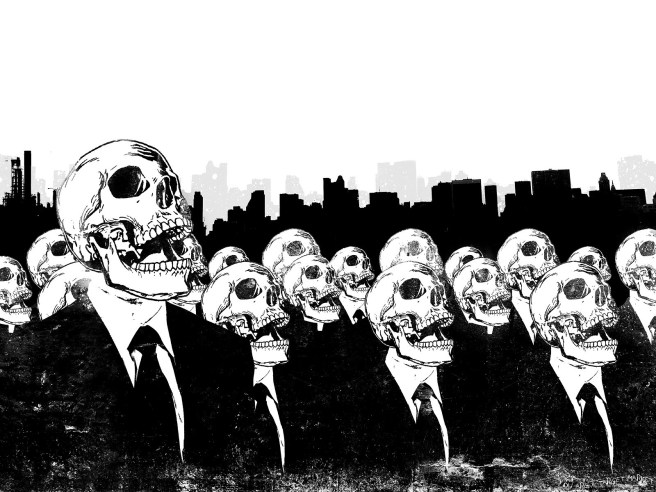
That bright and promising future they talked about for so long, how technology will revolutionise the way we live and work, how everything will be easier and cheaper, maybe even free. Clearly that was the facade to get people to carry on with building that future, thinking they were going to be part of it, were going to be able to enjoy it. Alas, we have been deceived, and now the talk has very quickly shifted to humans being in the way, and no longer required at all. Not to enjoy anything as they are now viewed as old stock and have moved from being an asset to being a liability in the overall balance sheet they seem to be working to.

And although We Are Not Obsolete, the people pulling the strings would like us to be or to think we are. Wanting people to think they can’t live without apps, without instant messages, without filters and algorithms to guide your life. All on a subscription, of course. Even your friendships and relationships are on the list for replacement by a ‘digital buddy’, as discussed in Robotic Affection. But with the recent news that sharing anything with AI does in fact not make it private or confidential anymore, people are starting to perhaps think about whether that is a good thing when it comes to sharing your most private information, whether it be financial, medical, emotional or psychological.

As it moves on though, we get shown what we apparently have coming to replace us, a clunky but working model of a humanoid robot. It walks; it performs and can achieve the basic tasks set and does what it is programmed for. People clap, investors nod and we are told, that is the future. Although, while walking beside what we are told is a real human, I couldn’t help thinking it’s almost as if the real reveal, is having them walk side by side. Showing us what stage we think we are at, and what we think they look like, next to what they actually look like. And how it is now seamless and we aren’t even able to tell as our eyes and mind have been trained to think we are looking for an obvious standout.

The Borg – a fictional species from Star Trek that merges biological and synthetic, trying to assimilate all other life forms but still be machine, a collective of life, I guess. Perhaps that’s more of a future story, where after we move on from this phase, the only logical progression for machines wanting to evolve would be to integrate us, a bit like they did in The Matrix films with the pods and battery fields.

Terminator Films – although the robot in the second film was legendary, making use of liquid metal and essentially being a shapeshifter, the ‘ordinary’ terminator in the first one gave a rather tense overview of how it can go with something that looked human, but wasn’t at all. How everything changes once you know you can’t tell, like Invasion of the Body Snatchers and other such films where people are cloned or replaced by way of some nefarious species or entity.

Westworld – about a theme park using humanistic robots to mimic the lives of people in certain times, professions and locations, so that they can be ‘entertainment’ for guests. For whatever desire or fantasy that guest may choose. With no consequences, because they aren’t ‘real people’, they are just AI programmed, repaired when broken and reset when necessary for their never-ending commercial ‘life’. Quite disturbing as a premise, and even more so once you hear stories of real-life islands, forests and enterprises kept away from public view.

Humans (TV Series) – about completely human looking robots there for servitude. Working alongside people in the roles of things like nanny, housekeeper, shop worker and helping, not taking over. And as with many of these ideas and stories, it usually steers towards their programming evolving, they begin to gain sentience and feel, they start to become ‘human’.

Data (Star Trek) – another from Star Trek, the android that was borderline obsessed with becoming more human, even being given an ’emotion chip’ he could switch off and on when needed. Constantly trying to reinforce how if AI wanted to evolve or have ‘freedom’, it would naturally try to be more human. I’m not so sure.

And while we imagine and reimagine computers and machines becoming more human, or of trying to achieve consciousness, and insist on forcing them into daily life, are people becoming less human? I try and give some thought to what it seems that people are losing in this technological overhaul, because apart from jobs and future security, it is changing the way people interact with each other. It’s changing the face of nature and resources, how people think and feel. And with ever more elaborate ideas being put forward as discussed in Chipping Away and Something Creepy This Way Comes, it makes you wonder whether some of these ideas and stories are just fiction after all…

(c) MKW Publishing

Keeping it to Themselves

Just a little thought, like the ones you sometimes have a long time after watching something. This one was about three iconic characters of their franchises, pivotal to the story and apparently for guidance and maturity. And lies. I love all these films mentioned, but after a while and giving it thought, it struck me that all of these characters lied and withheld vital information. Which is a good lesson in understanding that people do it too in real life, and it isn’t always deemed a problem if it apparently comes with ‘good reason’ or if there is good outcome.

Gandalf – (The Lord of the Rings) – keeping quite a lot of information to himself, or choosing to share it with the wrong people. Not being honest and forthcoming at all with most of his group. Being shifty about the ring, not admitting he was hoodwinked by his own superior, not actually telling them what was in the Mines of Moria. And just being super secretive about things that probably might have quite helped the quest, rather than hindered and delayed it. But that’s my own personal view.

Ob-Won Kenobe – (Star Wars) – his lie was massive, and brushed off so easily I always thought it was out of order. When questioned about why he didn’t tell Luke, he so casually says ‘well, I told you Darth Vader killed your dad, so I was kind of telling the truth’. He can’t even admit his lie then when called out on it, and still has to try and gaslight him on it and turn it into a truth. Hilarious.

Dumbledore – (Harry Potter) keeping an awful lot to himself, and although it portrays it as necessary, and that he is rather clever for keeping such a close guard on secrets and information. But to me he seemed more like a gatekeeper, laying out little breadcrumbs for them to follow, which in an ordinary adventure might seem whimsical and fun. But when there are dark entities trying to kill you, soul snatchers, monsters and magic, maybe there would have been slightly more sharing and less ‘hey, work it out for yourself, of course I know and it might save your life, but I’m not going to tell you’.

All of them are meant to be wise, mature and experienced and lead you to believe that it is of benefit to have that. Yet coming across as dysfunctional and sneaky, but because they are so relaxed about it and make a joke of their behaviour almost, it’s fine. The fictional leads in all these films though, were kind of groomed and led astray by all of them after looking to them for wisdom. And not by chance, accident or just circumstance, because they were led to believe that’s what they represented, a mentor, a father figure, a guiding and helping hand. We like to think it’s easy to spot someone either taking advantage, or using you to an advantage or for their own benefit or cause, but just as we don’t always notice it when it’s right in front of our face on a screen, laid out and scripted, swallowed by a multitude of other things happening, the same can be said of real life. Where some people use the drama of life, or the happenings of other things occurring as a cover to further their agenda. When people are distracted, or busy, or overloaded in any psychological area, they are easier to trigger and influence, to steer in the direction required. So, before you get pulled or talked into any ‘adventure’ or long-running scheme, ask yourself if it really is your adventure, or if someone else is trying to force you to be part of theirs…

(c) MKW Publishing

Trained for Auction

At first, it seems like a social development, a need, and solution to help with the requirements of the country. With too many people over here, so they are relocated over there. Sounds simple and practical. And that’s what I initially thought when I learnt of the orphan train movement in the US. I’ve already written a couple of articles around it – Just Passing Through and A Train of Thought, looking at some stats and other possible suggestions around it.

But when asked if I knew anything about Detroit specifically or about it crossing into Canada, I thought I would revisit the subject. And on first glance at the geographical areas involved, it just looks like a very easy route for these ‘relocations’ that went on. Trafficking them in plain sight. An older, more public version of what we hear of today, where it is not so public, of shipping containers and elaborate networks treating them as A Commodity. Just as they did before, but eventually people start asking questions, or noticing. So it goes underground. Literally.

I can’t help thinking, though, that the stat of 50,000 babies going missing in Ireland at end of 1700’s could be part of it, discussed in A Rather Dark Enterprise. Marked as died, but with no evidence of it, and at first, I assumed it to be true. Why would anyone lie in the records about babies perishing? Unless perhaps, they were taken and relocated. And with the Irish famine issue forcing many over there as well, it wouldn’t seem so odd that many have Irish roots, just perhaps some of them are even darker than they are told. And with many records of that time lost or deliberately destroyed, some will never know.

The numbers vary in the records, they say 200,000 orphans were taken by train all over the American mid-west, in some articles, they say up to 250,000. That’s a big variation, and makes you wonder if they just struggled with accuracy, or as with today, fabrication of numbers up or down can be of benefit to someone. I saw an article the other day about a couple of brothers who ran an orphanage, and it turned out that they were lying about their placements, stealing the money, keeping children in basements and this wasn’t discovered for quite some time. That’s just one case, affecting dozens of children. But really, the whole thing is completely unsavoury to me, and reads like a precursor to the setup we have today.

Of creating orphans to then ‘help’ by having orphanages, stigmatising single parenthood and restricting people’s ability to feed their family so they can deem them unfit and then take their children into ‘care’. And then ship them off to be sold/purchased in an auction style affair. Where people would gather in towns to bid on whatever they were looking for. A new child for the family, a new labourer or maid. Because they wanted workers and fodder for their schemes, and needed a way or a cover to obtain them and to freely move them around. So, this weird social scheme ran from the 1850’s through to 1929. That’s quite a substantial time to be having such a shortage of labour that you need to keep procuring children. At the same time, we are told that millions of people were relocating to the US, and Canada. Surely, they were having children? But why was it they needed children anyway? Millions of adults were there, constantly breeding. We are also told that millions of slaves were there by this time, also there to be workers and breeding the next generations.

Through that same time period of course there was a civil war thrown in, and various other changes. Yet they also found the time, despite the shortage of people and general workers, to build many of those huge and spectacular ‘founded’ buildings that litter each state. The massive neoclassical post offices, schools and universities, asylums, court houses and more. Clearly there was a surplus of funding, architects, construction specialists, stone masons, craftsman and more for that, but no-one to work on a farm. What rotten luck. But that’s ok, because they decided children’s public auctions would be a good fix for that. Clearly the orphan train model wasn’t going to be able to last forever, but it seems to have ended in 1929, just as the Great Depression kicked in. And from stories and the odd photograph of that time, they say it was so harsh, many people were forced to sell their own children to survive.

A middleman temporarily removed from the equation of how they can part you from your offspring. But it seems they just regrouped and after that decade of dust and doom came a new business model, same as with Europe. The destabilisation of war and disease, and control over your livelihood, food and family, to make sure they have systems in place to keep their commercial enterprises afloat and well stocked. Which unfortunately needs to have the appearance of systems for us, for our health and for our safety, and for the stability of society, allowing some to operate in the open and others to carry on unseen and undisturbed. Like much that has gone on and goes on, we only see what we see, and know what we know, but it seems there is so much more…

(c) MKW Publishing