“So you see pictures in your head? That sounds like witchcraft to me!”
And to someone who doesn’t visualise in mind, or have an inner monolgue, it really did.
It was from there I asked more questions and discovered one of us has Hyperhantasia and the other has Aphantasia, and what followed was quite a game changer.
There are many reason people think differently to one another, and I spend a fair amount of any spare time I have speculating and assessing why that is. Along the way and within my investigative nature, I discovered that my husband was Aphantasic. Meaning he does not have mental imagery annd doesn’t visualise anything in mind. And the reason we stumbled upon this revelation, was because it transpired that I over visualise. Hyperphantasia they have called it. And it was through this difference I began to unravel a huge amount of differences in perspective and attitude that went way beyond just personality and one of us being a man and one being a woman. Although i don’t doubt that plays a bit part.
But given the current social climate we find ourselves in, with very divided attitudes and beliefs, I can’t help but wonder what thought processes those people are going though. On both sides. Not just because of visualing or lack thereof, but of all the other things that affect how you make decisions and access your position in society. There is much to mull over currently, and maybe I will find my way to writing my next non fiction book.
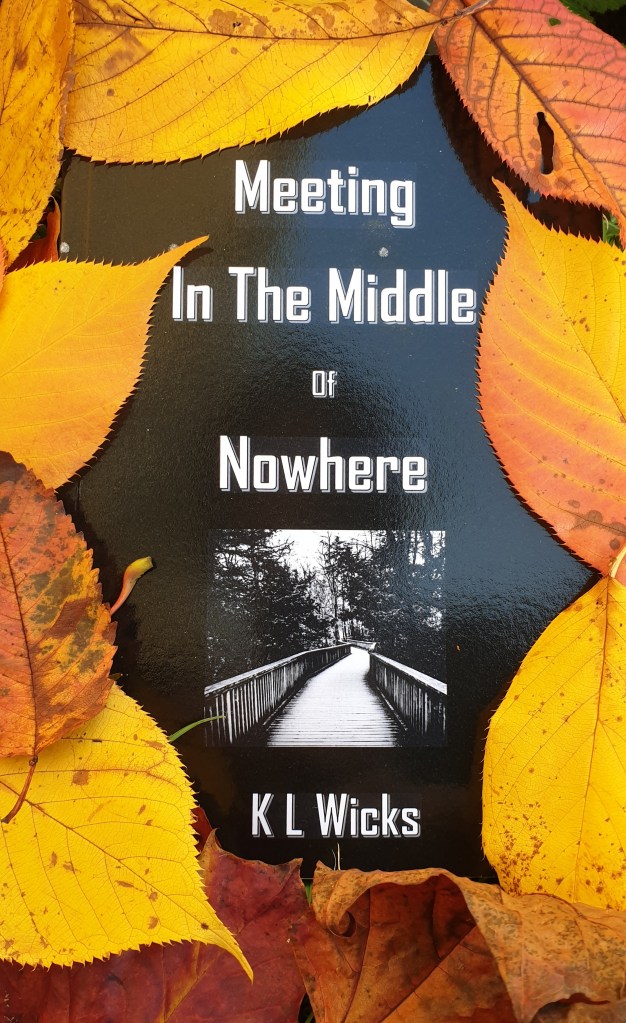
This is another chapter from my book – Meeting in the Middle of Nowhere, this one regarding a subject that has consumed much of my thought over the years. Once the difference between Hyperphantasia and Aphantasia was established, it led me to requestion this particular theme and review it from a completely different angle. (If you are not familiar with my book or these terms – I have Hyperphantasia = over visualising in mind and my husband has Aphantasia = lack of visual imagery) And in these strange times where many people are being openly manipulated through fear, it would be wise to understand what it is and how it can affect you.
Fear ~
When we found out about the difference in ability for visual imagery, one of the subjects I raised was fear. I wanted to know if he was affected by horror movies. Although he doesn’t really care for them, I know he had a phase of watching them when younger, and I thought, if he doesn’t get anything from them, why would he watch them? That is one of the areas that I always felt uses your own visual imagery against you, horror films. Creating tension with unseen horrors or just nothing sometimes, only a piece of music – letting your brain make up something more terrible than they could.
And I was correct. It was a flat no. He didn’t get scared watching them or any time after, because his brain literally imagined nothing during the scenes where you did not see the monster or alien. Long scenes of nothing but tension will often lose his attention, and rightly so I realise. Therefore, he never thought there might be monsters under the bed, has never been afraid of the dark or something he can’t see.
“Why would I be afraid of an idea?”
A very logical question, I felt, because without visual imagery, there was nothing to be scared of. He doesn’t visualise what might happen, he doesn’t put himself in the place of others, and therefore no emotion at all is attached. They are just pictures on a screen and when they are finished, they are gone. No recall or replay happens after the event. We can discuss concepts and ideas, but I no longer make any reference to anything visual or implied visual, there is no point and it holds up a conversation.
I watch less horror myself these days. Once I realised my brain was imprinting most of what I saw and could recall it at any given moment, I decided I need to be a better filter. My moods and emotions are greatly affected by what I read, write, watch and see, so I choose what takes my attention wisely now. I have spent a big portion of my life being affected by my fears and phobias, something he simply cannot relate to. I have a number of them and have learnt to manage them over the years. Some may be familiar.
Example: When I was about 8 or 9, I watched Jaws. As you can possibly imagine, it didn’t do me any good. It affected me so much I didn’t go swimming or have a bath for a year. Only showers. Because my brain decided to visualise and imagine jaws coming up through the plughole. Or in the swimming pool, the filter became my point of fixation. I had nightmares about the sea, about swimming, about sharks. It haunted me greatly.
After a year or so, I started to go back in the water. But with a very changed mind-set. Every water experience was a chore, an anxiety-ridden feeling I tried desperately to hide. I was a tomboy and wanted to be cool. So swallowed my fear and did it, along the way reading as many factual books about sharks as I could. Trying to dispel my unnatural fear of something that did not inhabit the same terrain as me.
Around the age of 12 there were a couple of experiences that reminded me I was not over it, just working through it. In the Army Cadets we were on annual camp and part of our training was being made to jump in a lake, swim out to a small boat and back to shore. Sounds simple enough. Let me set the scene as it really was – it was a grey February day, a freezing cold lake in the woods, and the water was black as night, zero visibility. I was the only girl taking part because the other three had managed to come up with excuses. My fear was so paralysing I couldn’t think about anything other than what they were about to make me do. All I knew was that I couldn’t bottle it in front of everyone.
As the only girl they tried to make me go first, but that is where I put my foot down, no, I would go second. I may have also watched the film Alligator by then too, which only added to my already massive issues. Watching someone else jump in first and struggle to the boat did make me feel a bit better. I was a competent swimmer so my concern wasn’t skill based. I jumped in, and as my head went under just for a second my panic hit a new level. The only reason I think I managed it was the adrenaline from the fear. That same mechanism got me bronze medal at the cadet championships too, for swimming. Visualising a shark actually helped me there!
I am still not over it, I just don’t go near the water anymore. I love swimming as a sport and exercise but it’s not relaxing or enjoyable for me. Or even being on water; over a decade ago I visited The Gambia on holiday and had to go in a dugout canoe, the rim was only a centimetre above the water line. I was so tense I gripped the edge of the canoe the whole time, with fingertips only ever so slightly hanging over the edge, crocodiles and piranhas being my fear there. Again, I was just trying to save face but hated the experience and that I put myself through the anxiety of it.
So I now avoid water still because of a scary film I watched. It sounds pathetic, but the struggle is real. To my husband, it sounds mad and he can’t believe these things have affected me so much, but he kind of gets it a bit more now. He just doesn’t get why I continued to keep watching films that would give me nightmares and real fears. Zombie films also have their place in my Hall of Horror Phobias, but I now feel I am trying to put it to good use by writing books. I am torn though; when you work out what scared you so much, do you really want others to go through what you did? It’s the author’s dilemma for me; just because I can, does it mean I should?
I have also observed that fear and anxiety can be and are used in conjunction with each other for manipulative purposes.
Example: After my breakdown my mother was my sole company for most of the day. At first she seemed to be trying to help me get better, then after a year or two, the rhetoric changed. Instead of preparing me to reintegrate into society and become a real person again, I began to hear things like,
“You’ll never cope without me.”
I think it was from that point on all I could focus on was getting old enough to leave home. I didn’t care that I might not cope and the world was scary, I desperately wanted to have the chance. She, however, seemed to be filled with regret and constantly talked of plans involving me and her in the future. I was afraid I would never get away which added massively to my anxiety. Obviously the events that followed did ultimately see me get my wish to leave, but at the cost of everything. It took me quite a number of years to work through all of that and put it all where it needed to be. I can’t say I had it harder than anybody else, but it was definitely weird.
(c) K Wicks – Meeting in the Middle of Nowhere.
Photo and words taken from the film V for Vendetta.
It’s no secret that people see things differently to each other, think differently and react differently. It’s pointed out to us often, within men and women hugely – a classic book I never got round to reading springs to mind – Men Are from Mars and Women Are from Venus. I have heard this book mentioned and referred to by title on many ocassions (never an actual quote). But almost possibly to deflect from the fact those differences can cause issues and it’s easier to breeze over them and wave them away as ‘they just are’ rather than address them. It can be hard to get along with, communicate effectively with and have a balanced relationship with someone if you are unaware of why or how you are different. Just acknowledging it exists isn’t really enough in my opinion if it’s a fundamental one. We give people many excuses for their behaviour often without delving into the reason for it. Or think that by giving it reasoning can go someway to excusing it. Not in my mind. I like to know the why, it usually helps me to determine any possible conslusion, judgment or result that may need to occur.
There are many reasons why people don’t get along, and with some people you never will. But I find it interesting to understand why, even if the fault lies with me, it’s still good to know that. There are lots of important lessons around this I think, helping to form how we see the world, how we think the world see us, if people have that concept. But understanding why you are different can actually help you to fit in. Not in the tradiontional sense of adapting to others ways and fitting into their pattern – but finding your own fit. To a point, we all have to get along; living side by side and weaving our way through life together (unless you have removed yourself from having to). But finding out who are can be a tough one and coming up against others opinions, ideals or wills can be a challenge when they clash with your own. In this modern time of instant and sometimes public ommunication, being aware of the impact of influences is important.
But it should also be factored in that ideals, thoughts and perpsectives can change with time and experience. Your own and other peoples. It would be odd to expect to be the same person at 40 that you were at 20, impossible in my view. So it shouldn’t be a suprise that you may ‘outgrow’ people as they say, or ‘drift apart’ or simply just change. All of those can be correct, and are ok. But if poth parties aren’t aware or mature enough to really understand that, then there can be difficluties and I guess, arguments and fall outs. It’s not easy when you may have outgrown someone, but they haven’t you.
On top of personality and general interest differences, there are the fundamental ones that can affect things. For that I will reference one that can go completely undetected, for decades and even life, but is a really important one in my recent experience. The ability to visualise in mind. Some people can’t. Most people can apparently, and there is a percentage who over visualise. Although they don’t actually know, they have presumed that only 2% can’t visualise – calling this Aphantasia, the small percentage, maybe 10% they say over visualise – called Hyperphantasia. And everyone else they say is on a varying scale of being able to visualise between not at all and all the time. That is what they used as the base ‘normal’ level.
I didn’t know this was a thing, until well into my 30’s. All my life I have visualised, over visualised and remembered much, places, dates, times, people, events, amounts, information. Usually relevant to my life, some of it outside events and extremely useless trivia that seems to hang around of it’s own accord. I naively presumed that everyone did this. So, the applecart in my mind was well and truly tipped over, when through various discussions and disagreements between myself and my husband, I discovered through continued questioning and reasoning what I consider to be a fundamental difference, and one that was actually the root of many of the issues. He did not visualise. At all. It sounds small doesn’t it? He doesn’t ‘see’ pictures in his head, and I do, what’s the big deal? I wish it weren’t one, and that it was just as easy as he is left handed and I am right handed. But the nature of what unfolded from that was more complex – there were different areas it affected firstly between us, and then indivdually. We also both had to content with understanding we really aren’t like each other or everyone else. And being honest, it can throw you sideways a bit when you just thought you were average and like everyone else. Then also realising that no-one else is really who you thought they were either. It can bring a whole lot of questions, and did. Opening a few more strange doors into self knowledge that I couldn’t help but venture into.
I then tried to work through it all and address which areas I felt it affected and why, trying to help my husband adjust to this new knowledge and explain to him as best I could, what is going on in peoples minds. While at the same time trying to integrate this new aspect of thought into my own assessments, of myself and others. It was a game changer for me and has given me an entirely different perspective on my past, present and future, and how I view and try to understand other people.
If you would be interested to read more about this experience, my book Meeting in the Middle of Nowhere is available on Amazon.
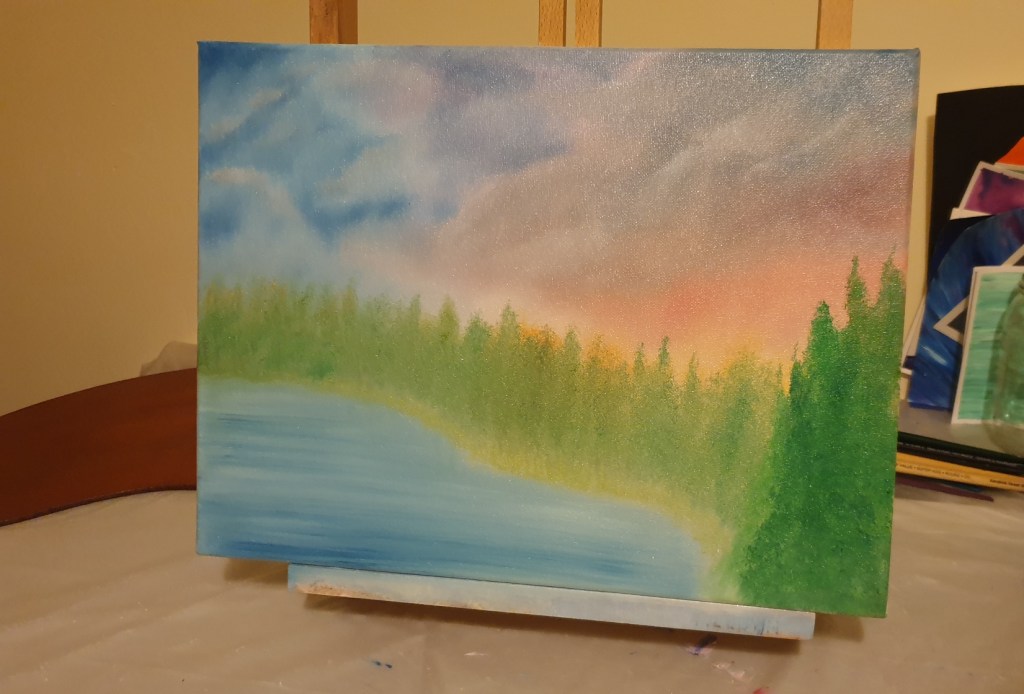
I’m still trying to make time for a bit of painting, and hope I have the inclination when I do. I want to paint nature, I’m just not very good. So thought if I set myself some goals and tasks, I could improve. Without copying an idea, I just tried to paint something. Perspective is one of my issues so I am working on that. Not great, but getting a bit better.
I am still not used to the consistency of the paint, how to work it, which brush to use and many other things. And by only putting a bit of time aside on weekends, it is slow progress. I am hoping to be able to do some more this weekend.
You know when you hear the phrase ‘not on the same page’? Implying that you are both not quite thinking along the same lines. When we realised there was a massive difference in thought going on, I realised we weren’t even in the same book.
We discovered that my husband is Aphantasic, meaning he doesn’t see any mental imagery in mind. I on the other hand, it turns out, am Hyperphantasic, someone who visualises most of the time. It may seem like a small difference to some people, and maybe it is to others, but for us it was huge. And went some way to explain why he just couldn’t understand my viewpoint on many things – despite various method of breaking it down or through logical explanations. Once we knew, I don’t expect him to understand certain things now. Because I can imagine what it is like to not have the ability – or affliction, to see images in mind, have internal narration (inner monologue) and recurring memories. In fact, once I did imagine what it was like to not have them, I understood him better and things made more sense. But the flipside of that, is that he can’t do the same. He does not imagine. So his understanding of me is limited, the best way I felt I could explain it was to write it down. Put in into sections of what areas of life I felt this made a difference.
From that came my book, Meeting in the Middle of Nowhere, describing what it is like to have Hyperphantasia and how I feel this has affected many areas of my life and experiences. And describing as best I can, the viewpoint on those subjects from someone with Aphantasia.
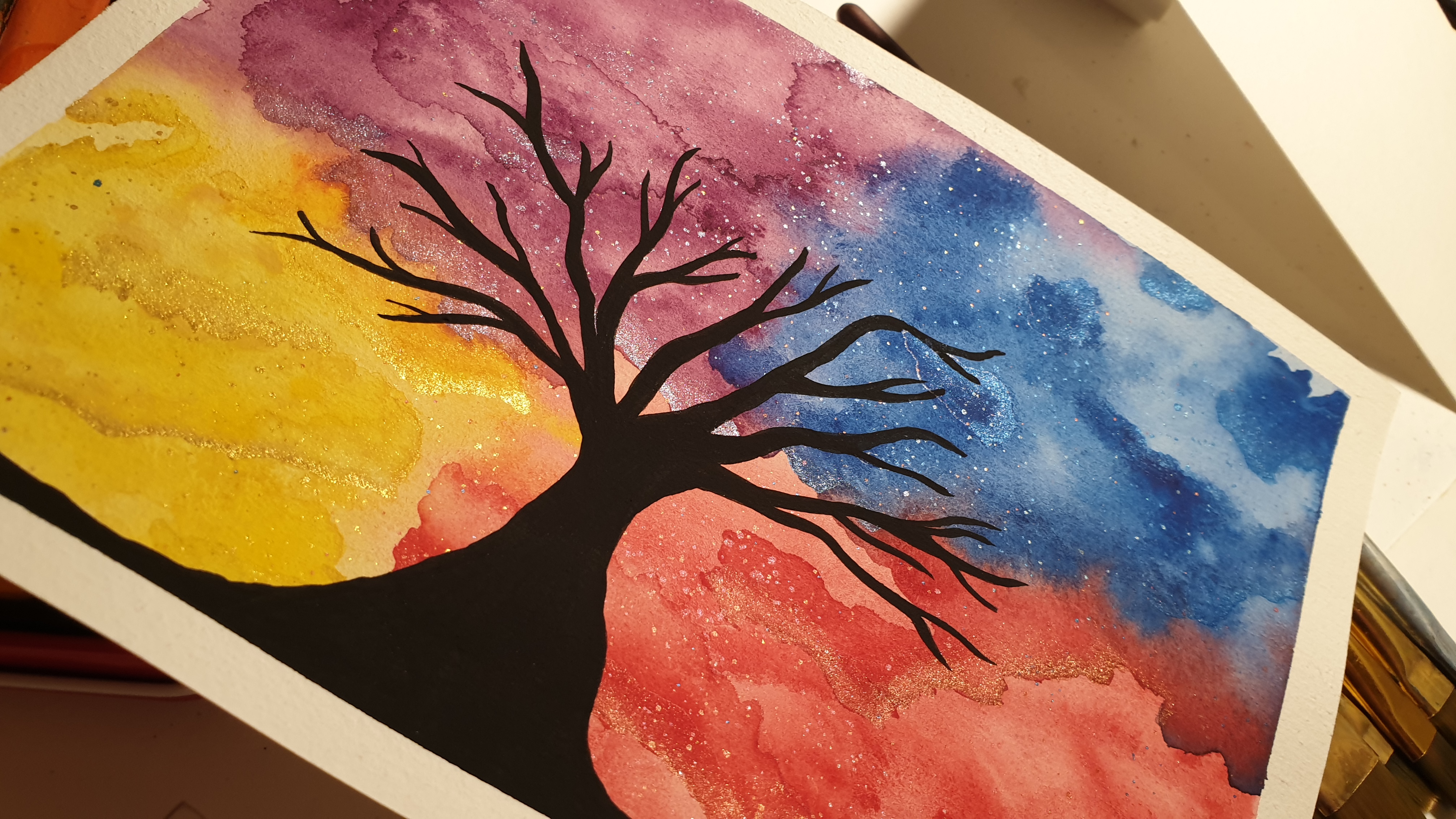
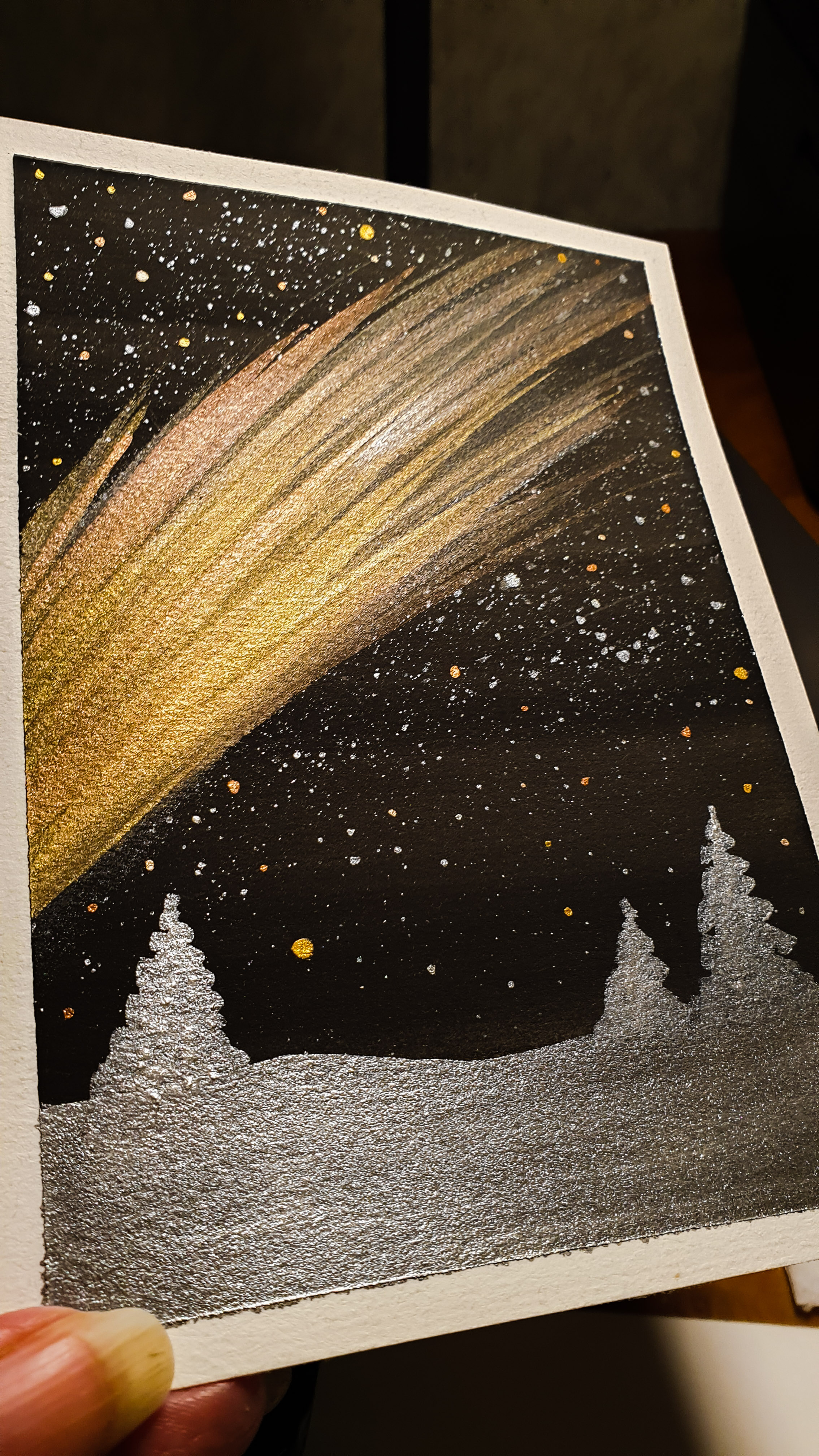
I am still trying to get onto the page what I intend to, and feeling half way through that it’s all gone wrong is a regular occurrence. In the end though, I’m usually quite pleased or just consider it a test piece 😉
Nature is still my inspiration at the moment. And liking a bit of sparkle too (which doesn’t come out so good in photos). Trying new trees this time, free hand so it’s a bit worrying at first thinking I’ll make a mistake. Or as Bob Ross would say, happy little accidents. Because they can be corrected or sometimes it helps the painting take a different turn.





 MKW Publishing