Aphantasia #2

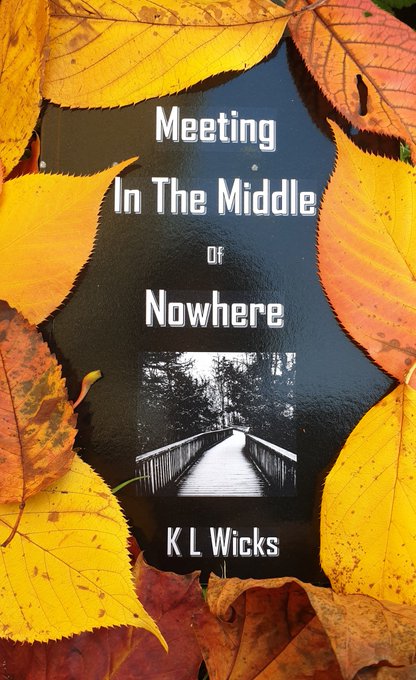
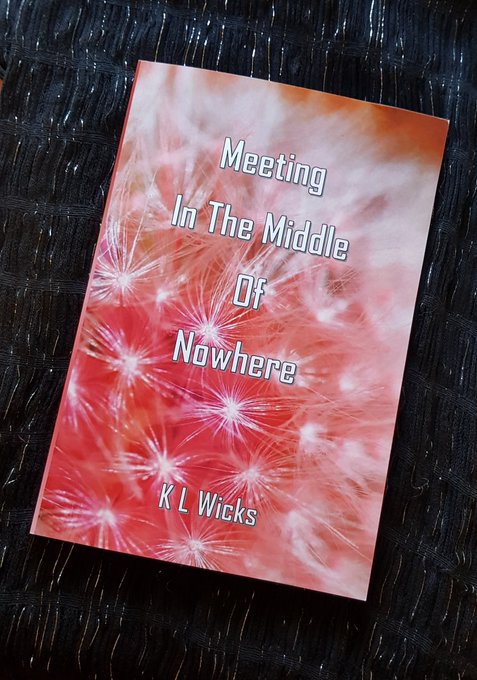
This was written nearly two years ago, and most of this has found its way into my book covering this in further detail – Meeting in the Middle of Nowhere.

“It’s been nearly a year now since I learned of this and have been trying to understand Aphantasia, i now know it is in varying degrees across the board for the people who have it, partial for some, full for others. I try as best i can to understand what it is to not have visualisation, to not imagine at all and to not picture anything in ones head, its a concept i had not considered but now makes perfect sense.

For full Aphantasiacs, the difference from partial seems to be startling too ( i can only comment on full as that’s been my experience). There is no escape from the stark reality before you, what you see is all there is – without dreams and mental pictures to carry you away, what you see really is all there is. I have the ability to replay movies in my head, run through what i saw mentally, recall faces, remember looking at lists, posters, people, i can see it all in my mind. But trying to explain that to someone who doesn’t, well, i have been told it sounds like the most alien thing in the world.

“You can play movies in your head?!” Yes. I can retrieve almost anything i have seen in my life, whether i remember it correctly is another matter, but i have something there. I can picture all of my family, past and present, i can imagine i’m looking in the fridge when i am trying to remember what i need to buy (when i forget my shopping list). I use it for so much, and also i realise, for escapism. Even just standing in line or waiting is assisted by my mind wandering, occupying itself with either something i want to do later, of something i might have watched the night before.

So, looking backwards and forwards is natural for me, spending possibly very little time in the present. Reviewing what was, and speculating on what might be. But not for one who doesn’t imagine – there is nothing to ‘look’ back on, and the future doesn’t exist. So living in the now takes on a whole new meaning, and seems that it can lead to immense impatience and frustration with the world and people. Mostly the people who seem to be ‘in a different world’. It’s because they actually are – which was quite a terrifying revelation to one who doesn’t ‘drift away’ in mind – while driving, cooking, walking, and everything else we do, most of us probably are mentally somewhere else. “So no-one is really in reality or sees the world as it is?” And that was the terrifying bit, the reality of that question.

I’m still learning on this and will keep at it”.

IMG_0147

(c) K L Wicks


Meeting in the Middle of Nowhere


PTSD

This is a chapter excerpt from my recent published work – Meeting in the Middle of Nowhere.

PTSD 

I wasn’t sure where this fit so it has its own small chapter. I also wanted to include it because before we knew of Aphantasia, my husband was actually rather dismissive of this condition. He said he didn’t understand why people were so traumatised to have this in the first place and why it goes on for so long. He can be extremely perceptive, so not getting it confused me and maybe because I had been diagnosed with this very thing, made me start to piece things together. Trauma and PTSD are different for everyone, but I believe memory and mental time travel made this last longer than necessary for me.

I had a breakdown and suffered from PTSD (Post Traumatic Stress Disorder – just in case you haven’t come across this term before) from the age of fourteen, then spent the next three to four years at home with just my mother. Very limited home schooling and little or no socialising outside of the house. Then just before I turned eighteen, my mother suffered a massive brain aneurysm. I’m not going to lie, it was the most shocking event of my life. Whatever trauma I thought I had experienced up until that point, was completely overshadowed. It was on my watch too, I was home late from an appointment mid-morning and found her, having to call the ambulance and deal with the initial fallout. We had dogs so I called my step-father and the ambulance left with her, leaving me alone in the house with the dogs for company.

But what I do find interesting is despite the awfulness of what was happening, a part of my brain kept functioning but in a very detached state. Reason and logic were working on a different level. It happened on a Monday, and although my older brother lived away, I knew it was his day off. So I didn’t call him. My reasoning being, I’m about to change his life forever, nothing will be the same after this. And although I desperately wanted company and to share this tragedy, I wanted him to have one more normal day. And he did, I told him the next day. So there is a part of me that does and can keep functioning when the other part of me has shut down. All I can call them are split experiences, I have access to both and took part in both, but which one I focus on can determine how I cope with them.

It has taken me years to get over that event. To make matters more complicated she survived, but not in a good state. She ended up stuck way up north where we were residing at the time, so very cut off from anyone. I was the only child left living at home and made the choice to not look after her. I left and chose me and my upcoming life instead. You may judge me as harsh for leaving, but if you knew the full background you would possibly understand. I was followed by years of guilt for leaving, having to find out what had happened in my life so I didn’t have to have it following me anymore.

It was five years later she passed away and although I was relieved, I was not left with a sense of peace for some time after. My guilt at not being there to save her, and for not looking after her kept followed me. Every minute of that experience is etched in my mind, and for years it replayed whenever it felt like it. But the whole five years it went on for too, and after the funeral. It’s for things like this that I do not appreciate having such clear memories with full imagery. The only thing I could do over the years was to dissociate the emotions that I had attached to them, gradually minimising the impact and effect it would have on me. My life is still up and down as I am, I’m just dealing with it slightly better these days.

After knowing people like me see images and memories in our heads, my husband did understand why PTSD was such a thing for so many people. Even giving me a bit of insight into how people without imagery may still be affected. He says that maybe by not being able to adequately remember or visualise a traumatic event end up leading to a lack of closure. You aren’t able to work through it and put it behind you. I know it’s different for everyone though so it’s always going to be hard to say for sure.

(c) K Wicks

Meeting in the Middle of Nowhere

A Sense of Self and Identity…

Chapter from my recent book Meeting in the Middle of Nowhere, looking at #Aphantasia #Hyperphantasia

Another question that I felt I should approach, was to ask if he had a sense of self. He didn’t know what I meant and I explained the term. This is something that has taken much of my thought. How the world views me, how I view myself and the world, all the things I feel this encompasses and can affect about a person. Being able to do this has helped me with each identity crisis I have gone through (and possibly caused some of them), helped me make friends, improve my career and assisted me generally in life.

So if someone were to not have a sense of self, I felt this would lead to feelings of a complete lack of identity. But without the concept of self and therefore identity, it seemed there was nothing to lack. It is only when I explained how much the sense of self affects ego and people’s motive and actions, he began to understand. And I was wrong, there isn’t a lack of identity at all, in fact, there is a person who knows what they want and who they are without the need to question it. I envied this slightly.

It’s like explaining another world to someone who has been travelling alongside it their whole life and didn’t know. It was quite a shock to reveal how apparently 98% of people function and think (within the parameters of what we know anyway). And the consequence of that was to cause him to rethink everything he thought he knew. It was hard to watch and to know I had opened that can of worms.

It’s almost like the scene I guess from the 1988 movie ‘They Live’ when he puts on the sunglasses and sees that most people aren’t like him. It throws you and makes you question everything. Added to that potentially having SDAM meant any attempt to try and recollect things was hard work. To try and work back through what has come before to understand yourself, when you have minimal data stored about it can cause great frustration.

I also realised this meant possibly most terms that start with self may be in the ring for being different. Self-esteem and confidence was one I wanted to explore further, because he appears to genuinely not care what people think of him. I wondered if this had developed because of his lack of sense of self, or perhaps the no filter honesty streak. That he might have received such a shocked response on numerous occasions without understanding why, that he developed thick skin as a side-affect.

I theorise it’s because without an ‘image of yourself’ how do you think about how others see you? How can you interpret what others may think of you? Learning this was quite pivotal in growing up for me and I didn’t know how he might know or work out what others would think. I now know, he doesn’t know what people think of him. He’s very perceptive about others intentions though and can work people out quicker than I can, but building a picture of someone in his mind doesn’t occur. Or the concept that other people may have a mental picture of him.

Mine however works very differently, I am very aware of how the world may view me, or how I would like it to view me. My thick skin developed over time and through logic. I found it easier in the end to unravel why sometimes I was being an idiot or hurtful and change those tendencies. Not to take anything to heart and let it get me down or let it be the motivator for a life decision. People can be a major influence on your decisions without you even being aware of it – but really it is only the perception of what they think that affects us. Often tainted by our own experiences or outlook. Perspective can be a great thing, if used when needed.

But having a sense of self is what has helped to drive me forward in my life, helped me to look at what I want to aspire to be and to do it. Without that self, I am not entirely sure who would have been steering the ship, so to speak.

My husband does not aspire to be anything in particular other than what he is. He has no ambition, and frankly after piecing it all together, I am not surprised. There is nothing until it happens, so what would you focus on as your goal? How would you have a five year or multi stage plan? He worked hard and just got on with life. Fortunately I look at people and who they are, not what they do for a living or how much money they make. Although I have ambition myself, it’s not something I presumed everyone else would have. I don’t judge someone for not being like me. In fact it seems strange to have that expectation, how can anyone be like me? They haven’t lived my life or seen what I have seen. It’s far more interesting to me to see the differences in people and work out how they came to be. We are all different, I just never saw that as a bad thing.

(Meeting in the Middle of Nowhere).

IMG_3026


The Holiday (Movie) and Hyperphantasia

This isn’t a normal review a because it’s not about the film as a film but more a point of interest within it – but can say that although watched all the way through didn’t quite deliver. Face to face I can talk about them for hours but online I try to keep it brief. This is your average rom com with popular leading actors. Cameron Diaz playing one the leads in her bright smiley way (she is pleasant to watch). But the reason I bring up this film in a non review context is that there were three specific moments that perfectly showed what I think Hyperphantasia is or at least it gave a good visual representation of it. Which was actually quite handy as my husband has aphantasia so for him, he can’t ‘imagine’ what’s it’s like. This was a good way for him to actually ‘see’ what I had been trying to tell him about my sometimes seemingly neurotic brain.

The two examples that stick with me after the fact are –

She is trying to sleep, and the next day starts running through her head, almost causing a panic attack because it was so frantic and busy. I know this process well. And the second is when she is explaining to the potential love interest why it wouldn’t work out and runs through the entire scenario she has already worked out in her mind. These two things in particular were exactly what I do (although this movie wasn’t anything about hyperphantsia), and until I knew how my husband thought, I had believed everyone had this frantic level of thinking, planning and general on stop thoughts. I think I believed they just managed it better than me. It turns out on the whole not everyone does, but then there are those of us who do…

IMG_8661


(c) K Wicks

Chronesthesia (Mental Time Travel)…

During the writing of my recent book, ‘Meeting in the Middle of Nowhere’, i fully believed I was investigating my husband. We had discovered after a year or two or marriage that we weren’t quite on the same page about a great many things and this led me to ask a lots of questions. I like to know the why’s and how’s for things. I don’t mind people thinking differently or having another view, but I like to know why.

But once we discovered the why, Aphantasia, it was a snow ball effect thereafter. The more we learnt, the more it changed how we saw ourselves rather than each other. And in learning more about Aphantasia, I stumbled across Hyperphantasia. It fit, a little too perfectly. Like him, I thought my brain was just like everyone else’s. I thought everyone else had to contend with constant imagery, internal monologue that won’t shut up, with past thoughts coming back from nowhere. That everyone had dreams and was afflicted by thoughts, ideas and life all jostling for position, in their head. Apparently not. It was my turn to be shocked and a bit taken aback.

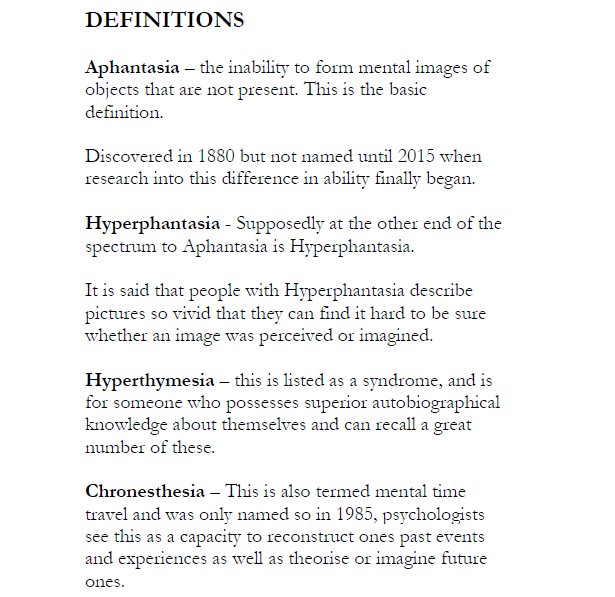
There more I learnt, the more there was to learn, but it felt like things were finally finding their place in mind. One chapter in the book is dedicated to Chronesthesia, what they call mental time travel. It sounds very silly to someone with Aphantasia it turns out, but not me, because it was exactly what my brain does and what I had been trying to explain to my husband. Unfortunately this process seems to go hand in hand with anxiety so it’s got to be managed like all the others. Once you know what your brain is doing, it can be easier to keep it in check!

MITMON LEAF

So you see pictures in your head?…

When we realised there was a difference in how we thought and general processes of the mind, I had no idea what it would lead to. It seemed like a small thing at first, he didn’t visualise anything in mind, or dream, or imagine. Anything. At all. Aphantasia. I do, almost constantly in fact. Hyperphantasia. Both at either end of a newly termed spectrum. It explained a lot. And so I found my way to understanding this difference a bit more and to write about how it affects us, how our perspectives of life differ more than we ever thought, and just how it has impacted our understanding of each other.

MITMON Front Cover

Sounds like witchcraft…

Excerpt from Meeting in the Middle of Nowhere by K L Wicks

It was through fiction though this all came about. I write horror fiction novels and short stories as well as nonfiction, I have always wanted to and have been writing and reading since I was a small child. I don’t mind that other people may not like the same genres or even reading fiction at all. Each to their own I would like to say. But my husband didn’t just not like fiction, he saw it as pointless and felt the need to tell me this.

I was dumbfounded at first, how could someone not see the benefits of fiction? Of being able to escape into a world of make believe and have a break from reality. Even if it is not your thing, why be dismissive of others getting enjoyment from it? I thought this was quite mean.

I tried to explain the merits of having an escape if you have a shitty life or reality might be a bit hard to process. He didn’t understand the concept of being able to escape reality.

It took many hours over a number of days for me to finally ask the right questions (trying not to make him feel like a test subject), coming to the conclusion of what was going on. I put forward the concept he had not considered or realised. I explained that when I read a book, my brain makes pictures up to accompany the words. Or that I can replay movies or television I have seen.

“You see pictures in your head! That sounds like witchcraft to me. I can’t think of anything more alien than that”.

We had it. We had found the difference that explained why he thought fiction was pointless. But that was the tip of iceberg of what was meant to be a simple explanation of why he didn’t see or like things the way I did. With a little bit of internet research I found the name. Aphantasia.

IMG_0839

(c) K Wicks

Meeting in the Middle of Nowhere –
What do you see when you close your eyes?…

If you don’t have any visual imagery in mind, it seems life is a very different experience compared to someone who does. It’s been a big learning experience to discover my husband is Aphantasic and along the way worked out I am hyperphantasic. I have written a book to try and describe what the differences are like, how they affect day to day life, and how they can give you a new perspective on everything you thought you knew.

Meeting in the Middle of Nowhere.