
What we believe we see seems to be a matter for debate. And although I was aware that people have differences in depth perception, and perceive colours differently to a point, I believed if you weren’t deemed colour-blind, then we all pretty much saw the same ‘colours’. There is also the subject of colour synaesthesia, where people will ‘see’ colours for things that you wouldn’t ordinarily have the need or ability to assign a colour for, but when hearing the word, letter or concept, the brain conjures a colour to accompany it. Of course, there are probably varying degrees of that as well, and until someone talks about it, or mentions it as a thing, they may just presume everyone does it. Same with Aphantasia and Hyperphantasia, discussed more closely in my book – Meeting in the Middle of Nowhere, of some people not having visual imagery in mind or an internal monologue. Sounds like a routine thing to acknowledge or understand, but when it’s discussed in real time from each perspective, the real differences in thought processes can be startling.
But it seems there are all sorts of other smaller differences going on too, that most of us still aren’t even aware of. So subtle or unnoticeable that they never get brought up or mentioned as a point of discussion, as it would seem as boring as walking up to someone and trying to start an interesting conversation by observing they have arms. Now, if everyone else was armless, then it may be a conversation starter, but we don’t walk around asking people if they see a blue sky if it’s a clear day. You’ll comment perhaps on that nice day, but not usually to clarify that the other person is also seeing a blue sky. Although, maybe we should be. The below picture is from a documentary I watched recently, and was quite surprised by two things about this image. Firstly, that there is only one colour in the image, and the ‘other colours’ aren’t actually there and your brain is filling it in for you. That confuses my brain, because I believe I am seeing four colours, but the second strange thing, was when the arrangement of colours was read out to go with the image, it did not match what I was seeing, they say the arrangement is as follows –
Top left = red / Top right = blue / Bottom left = green or aqua / Bottom right = orange
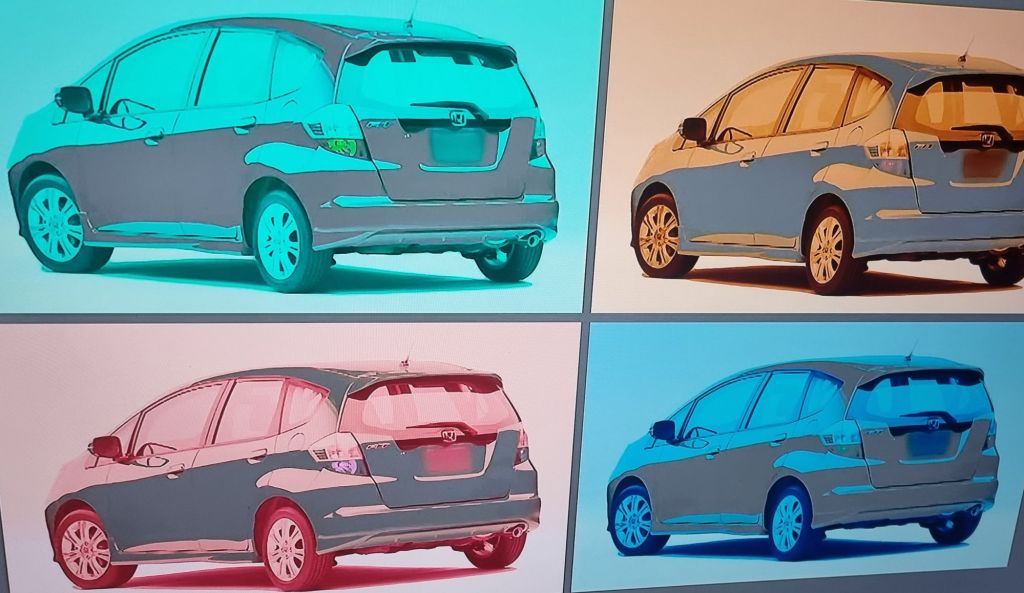
However, it is also seen as –
Top left = green or aqua / Top right = orange / Bottom left = red / Bottom right = blue
Yet the only colour available they say, is grey. Quite an odd one, and if there wasn’t a difference when the person on the screen casually explained the ‘colours’ being presented, I wouldn’t have wondered any further than the grey to colour aspect. Now I question how each brain is deciding to rearrange those ‘colours’ and see them differently to another brain. Does using the right or left side of the brain more dominantly determine whether the image colours are seen in reverse? Seems there really can be more to something than meets the eye…
(c) MKW Publishing
 MKW Publishing