
I happened across the history (or at least part history) of Benin, in Nigeria. It is said it was once a magnificent huge city, with wealth, structure and millions of inhabitants. Bronze was the main metal in use for wondrous sculptures and artifacts. Pictures of these are around today, because of relics stolen in past times being given back. That’s what led me to it, and to want to read more. I’ll mention the other piece of ‘evidence’ that made me want to know more. A letter, written by an englishmen in 1955, referring back to 1897, when the British arrived in Benin. It painted a horrific picture of what they arrived to, making it sound like the predator alter in the movie – part of that letter below, but with the extra line the internet one I saw omitted at the time, clearly outlining how that particular practice came to be. In fact, the entire ten page letter is an interesting read.
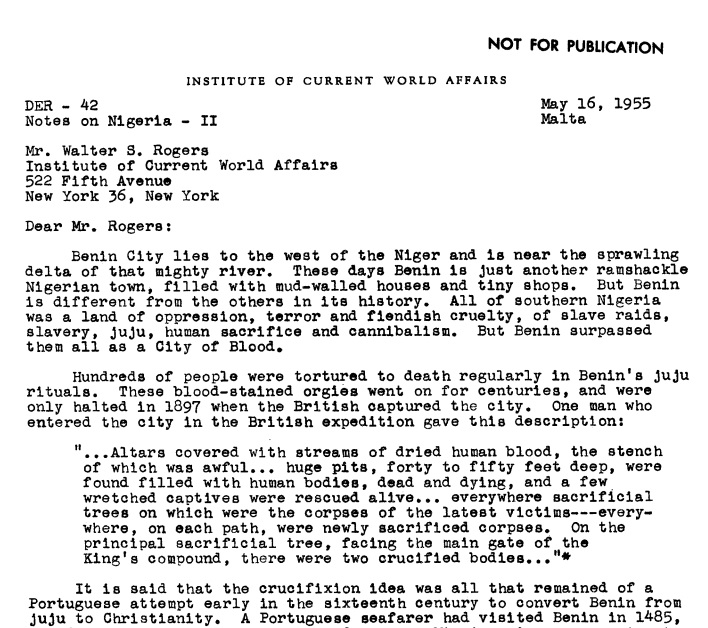
It seems that after that 1485 visit, missionaries were sent thereafter. Sounds familiar doesn’t it. And can be said of many of the great cities of the past, in Africa, South America, and places we don’t even know of because it has been so neatly covered over and forgotten, and not by accident in many cases. Where land grabs and changes of rulership happened, previous kings and emperors being coerced into agreements, people being made to play along or given incentives, sometimes torture and death was needed to help to ‘convince’ them it seems. In the above case, the letter goes onto detail how much that particular kingdom was diminished, and how they had to bargin and negotiate with ‘government’ after that for land, resources and what appeared to be a type of freedom. Slowly it changes into what we see today, with the story being that the rest of the great city was actually destroyed by the British in 1897, and people had to flee. Each continent has had its fair share of strife, people movement and invasions, back and forth with something being gained by someone each time, and great losses and displacement on the ground, so this isn’t a unique story, but interesting to me none-the-less.
(c) K Wicks
 MKW Publishing