A reading of my article – Reacting
(c) K Wicks

It’s getting brighter, and even more mushroomy.

(c) K Wicks
I have written many articles about society, and how it appears to have been engineered and people’s lives and attitudes shaped quite intentionally, and know I am not the first by any means to notice this. And of my recent ones, Leading to a State of Mind looks at how women have been geared up to have a certain way of thinking towards ‘opportunities’ presented or afforded to them by society – as well as my article Digging for Gold, or Freedom?. But alongside that, I have also noticed and have been discussing the other side of socially engineering the mentality of all people across the board, towards fear and its effects it can then have on controlling people and influencing their behaviour. See articles – Living in Fear, and Living in Fear, An update for how the various tactics were laid out over the years from a certain perspective.
It’s only more recently though I have come to realise that it is many things that have been used for purpose. And once I start to unpick them, or give thought to how or why you might orchestrate certain events, it seems there is much to see. I gave it thought towards serial killers that have been made infamous by way of media in Nature or Nurture?, but will come back to that type of subject, where the media plays a pivotal role, and people’s thoughts are infiltrated with horrific events, possibilities and outcomes to contend with.
Recently I saw talk of milk cartons, and the marketing campaign of missing children being printed on them that swept through in the 70′ and 80’s I believe it was. Now, I have come across this subject before, but more the extra sinister side of it where it crosses over into the realms of the Nephilim, clowns and all sorts of strange things. But the idea was put forward, of there never being any missing children, they were all apparently fabricated – which I have to admit, I still hadn’t considered. But why would they do that you might ask? As I did. Well, if we were to look at it through cynical eyes, one could say it was for the purpose of putting fear into the minds of children, to make them afraid and seeking ‘safety’ in the authorities, with a daily conditioning reminder by way of the breakfast table. Knowing that would be the sure-fire way to get them each and every morning as you couldn’t rely on children watching the news or reading the papers now, could you? It then plants the seeds for parents also feeling afraid for their children, paving the way for more restrictions placed within the family structure, by the family structure. The authorities can then appear to offer further restrictions as ‘help’ in the guise of surveillance solutions, funding, laws to help curb the new fears lurking on every corner – but never actually preventing them, and in fact leading to more of them often it would seem. Neatly captured and exposed with all the gruesome details laid bare in the media, the shock, the horror, the aftermath, the lessons and changes to take place thereafter to bring about whatever mentality or rule required.
But some people fail to see the purpose or fallout from said changes, or even notice they occurred in some cases, thinking maybe it was always that way, or easily forgetting what came before or thinking it was just a natural consequence of ‘normal society’. The social and mental implications of events have always interested me, from reading about terrible things in the past, and then wondering on how that might have changed the general mindset of people. Or conditioned them for a new way of thinking, it is not hard to influence people, and if you do it at the right time of their life, it seems you can create all sorts of issues and worries thereafter. Creating a heightened state of alert, or concern, or focus for the fear so it can grow, be nurtured and then be steered or manipulated when needed. Knowing if you have primed people for a certain response, then mostly that is how they will respond when faced with a similar feeling or threat. Then placing triggers and traps along the way for those things to stay in the psyche, or be activated when the time is right, Laying the Foundations for what is to come…

(c) K Wicks
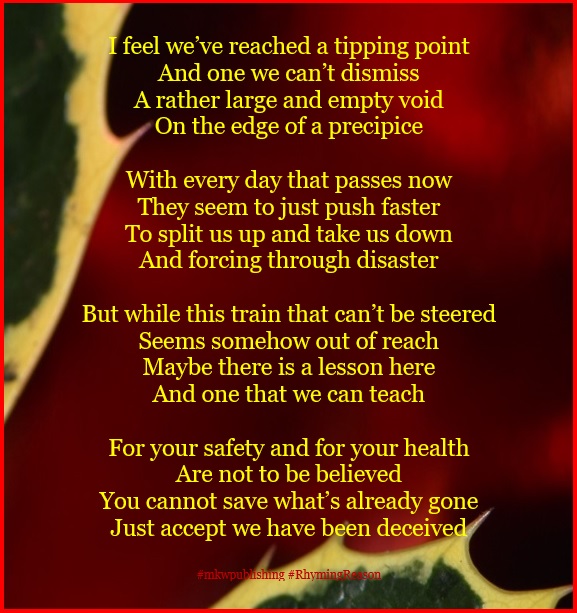
It seems we’re trapped in a grand delusion
Hypnotized by a group illusion
Drip fed horror, seasoned with fear
With extras of grief, making it clear
How we are viewed, as though wood for the fire
As expendable products they want to expire
Giving the tools to dehumanise
Then it becomes like it was in their eyes
Rather than helping and giving some hope
Instead, they look down and hand you the rope
Making it harder to just get on by
Nudging and wanting you just to comply
But behind that deal to help you to cope
It’s just a different type of rope
To keep you tied to the systems need
Consuming people, it seems that greed
~
Has taken over
(c) MKW Publishing
Perfection is a strange thing, and can be down to the viewer or creator to decide. Each person’s perception and idea of what perfection is, determining whether is it good enough, or not quite, as it has to be ‘perfect’. And we have people here and there who are called perfectionists, ones who cannot stand not to reach their own standard, and it usually gets put above others’ ideas of it.
But why do we seek perfection when it gets like that in mind? Is it because there is a random perfection to nature we want to emulate or believe we are capable of but not achieving? Or is it because there is so much chaos, we think we can create perfection through order, completely overlooking the beauty and order that can be found in chaos. Instead focusing on the rigid parameters we believe lead to that attainment? But even then, it is only a matter of opinion mostly, someone else could still find fault in it, or an improvement found or thought of. Beyond what you have seen.
In these current times though, people seem rather taken with how they appear, with a want for what is deemed a perfect aesthetic, beauty. A standard set by industries and reinforced through more industries, using the psychology of people and our predisposition to vanity and ego against us in the bigger scheme of things. Giving a tainted view of what is considered perfection before we even understand the concept of it. That saying we have ‘beauty is in the eye of the beholder’ should not be overlooked, as it is a good example of how perception ties in. I have already talked about Perceptions of Self in a previous article, but think it’s important to understand your own view and standard towards these things.
The need of the perfectionist, once allowed to indulge their perceived standards, can rage out of control somewhat. And result in all sorts of tragic and abhorrent views and behaviours. Mix into that personal desire, experience and resources, then you get a possible disaster. Because if that said type of person were running the show, they would make life hell for everyone else who they deem not up to standard. Setting impossible targets and goals others will fail at, leading to the compounding belief they were right, you weren’t good enough, attractive enough, smart enough. Or the right colour, or from the right place, and so on.
If someone or something is trying to convince you that you aren’t good enough for any reason, rather than jump straight to feeling bad about it, or taking it personally, firstly think of the motivation of the teller. And why they would want you to think you aren’t perfect, is it because it reveals that it is they who think you aren’t perfect and require it to be deflected, so you will try and please them, change yourself, for their ideals. Rather than call them out on their unrealistic and unhealthy view. Society functions like that too it seems and can be observed as well in personal relationships, family dynamics and anywhere you have people really. And having a standard isn’t the problem, it seems to be once you believe everyone else has to adhere to that unrealistic standard. That is where we definitely have a problem…

(c) K Wicks
(c) MKW Publishing
Women and reasons they do not want children these days, and why they might want to have abortions is something that has been in the mainstream of late in various forms. Aside from the modern argument that currently exists, I saw another angle mentioned on a podcast, about how society has steered some of these mentalities. So, I gave it thought having seen women screaming at each over it at protests online, as well as try to have a calm and well-reasoned discussion.
Although I have recently written about orphans and how children have been used as a commodity, as a tool of society and conditioning and of leverage. (See articles A Train of Thought and A Rather Dark Enterprise). I can see that women have had a strange set up too, as the ones who are required to birth the next generation, expectations and demand clearly have played their role.
We are led to believe that it starts from the top down, with a royal expectation for a male heir, and then it filters down. And in general society also, with very different roles ‘of the household’ moulding the mentality. Slowly moving away from family structures and natural processes, instead to be replaced with updated quotas and interference. Because there has been interference of some kind for the longest time.
Being told you do not have absolute right over your offspring, being denied a place in society if you get pregnant outside of the rules of wedlock. Not allowed financial independence, therefore placing burdens of breeding on women without much freedom outside of that. For hundreds of years at least, as well as being educated to a lower level, or not at all. All plays its part in creating a certain landscape and state of mind, passed down through the generations in many cases. With the trauma and conditions of that time being felt for more than an age after, and the continued Social Status and stigmas to carry it all on.
And of those rules, some led to other behaviour, very much not a maternal one. In the Victorian times, they had nurses who would take on the care of others children. One in particular actually murdered over 400 children and babies it is said, check out Amelia Dyer if you are unfamiliar with that. But it was a baby farming enterprise she was running, and women gave their children to her, and paid her to look after them. A strange case really, and as it led to stricter laws on adoption and the formation of the NSPCC, I have suspicions about its authenticity. But the idea that women needed to offload their children, or pay someone else to look after them, or adopt them, leads me to ask why?
With our current engineered cost of living crisis, its easy to see how society is set up to create the conditions necessary for things to occur. For a state of mind to develop, to see children as potentially a burden rather than a blessing. The joy of parenting being replaced by the stress of survival, with your landscape being remoulded and redefined within that.
And it’s not just casual interference being added to that, when you think of the rules that surround breeding or the laws created to ensnare you into ‘the system’ by way of your children as if it’s one big baby farm. With more extreme outcomes in some cases than others, with caps on numbers and certain sexes favoured over others.
I saw a clip of an Indian woman last year, kind of casually explaining how she had killed 9 of her own babies over the years after they were born, because they were girls. There was no compassion or remorse in what she was saying, but there was a worn-down emptiness to her expression. Fear seems to drive an awful lot of the reasons put forward, fear of being judged, fear of failure, fear of not affording it, pressure or influence from others. So many reasons, and most of them sound like a product of society and reasoning, not instinct or nature. But within that instinct and nature will be intermingled, and perhaps why it is such a fierce debate. Carrying forward centuries of injustice mixed with modern logic. I guess that could be said of many things these days.
But the overall mentality of women, their perceived worth and thought process towards things has been a long time in the making and is nurtured, but not in a maternal way, in fact quite the opposite. And all of those rules and restrictions had a price and an effect, which could perhaps be part of why it’s so split between people on the ground in society. The For and Against battling it out, all leading to a certain state of mind, where the state is always in your mind…
(c) K Wicks

(c) K Wicks
 MKW Publishing