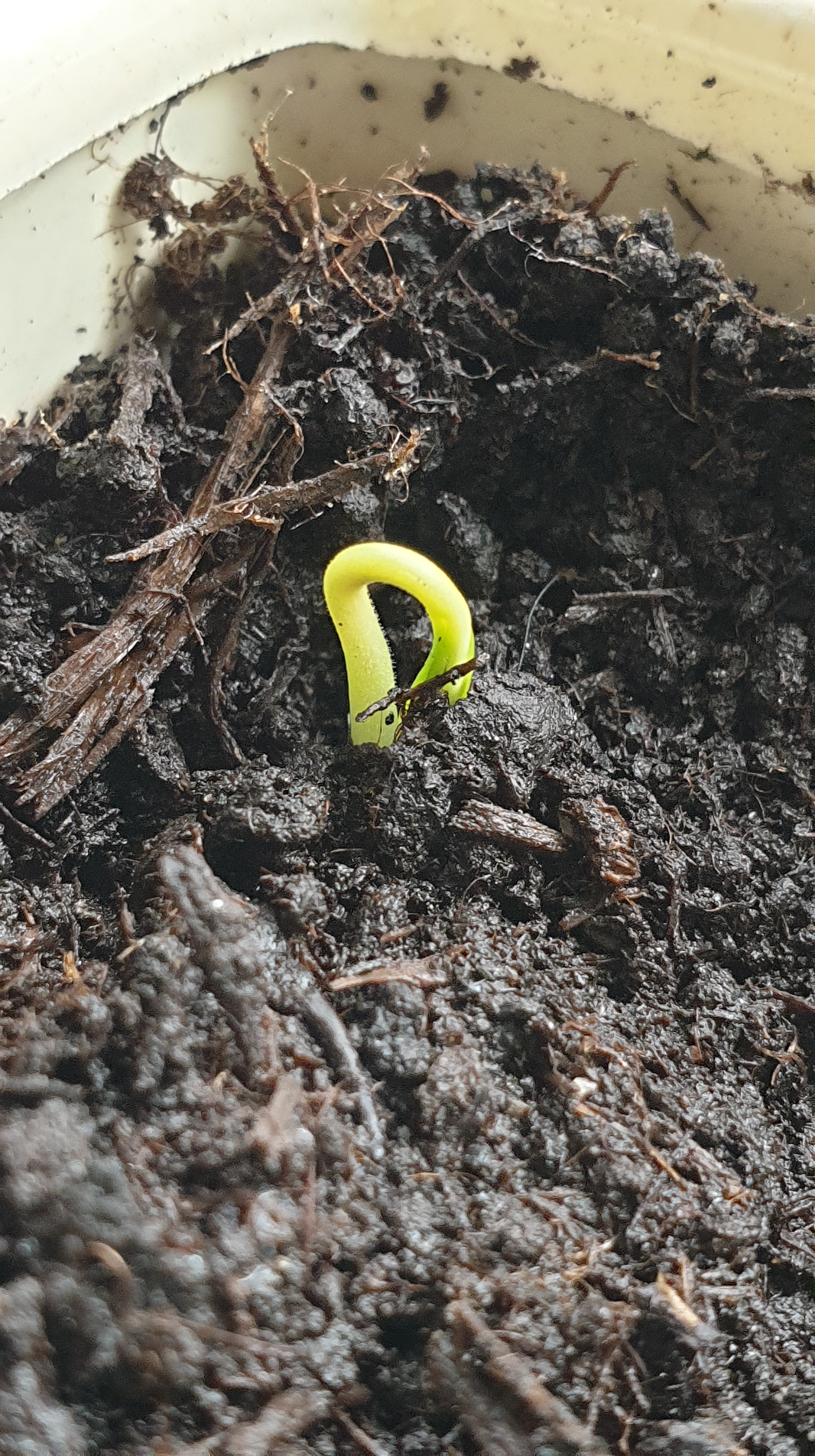
On my journey of growing things, I am trying seeds wherever I find them. I put a few sweet pepper (capsicum) seeds in to grow before throwing away. And they have sprouted 😁 I really don’t know where I will grow all this stuff. I have more seed planting planned for the weekend as well after buying a pack for some winter veg. But the potatoes are ready for digging up – I actually had a few for dinner the other night, which means there will be some space at the back of the garden. We shall see how it all goes.
I’ll try and share updates of these little guys, and my other projects if I remember to take pictures as I go!
As mentioned briefly in my other post The before time, I want to talk about mobile phones. I have never been a fan of telephones, as an invention, yes, it is fantastic. For personal use, no. I do not like talking on the phone, for a couple of reasons. Firstly, I don’t like my phone voice so it makes me uncomfortable the longer the conversation usually goes on. And secondly, I cannot see the persons face, so I find it hard to engage for very long. I can imagine them, but it’s not the same. Facetime suits me better if I have to.
It started with landlines though, before they were just used for the internet. I hated ours. I hated the unpredictability of when it would ring. A shrill noise to cut through your thoughts. A doorbell has the same effect. And an alarm clock when set. I also have neither of those in my life. To me it was the intrusion into what you were doing, as well as suddenly having to muster the energy or want to talk to someone. Going in blind to a conversation with potentially a complete stranger.
So fast forward to mobile phones. They designed something so that you could be reached by anyone with your number, all hours of the day. Great for business or if you need to be reachable. Other than that, it became a burden to me very quickly, and I suspect other people too, a source of anxiety and stress. Until one day, after having quite severe anxiety issues because of being called and texted every day by the same person, I decided to take control of it and not let my phone or someone else influence my moods too much. It was simple. I switched off the ringer. Silent. And it has remained that way for over 10 years now. I also run a business and it was one of the best things I could do for it. I stopped getting interrupted, was still contactable, just not at the convenience of other people. I was available at my own convenience. I worked out the root of my issues, identified them and took steps to sort them out.
As the years have gone on it has changed even further. Smart phones now instead of just mobile, suddenly it wasn’t just a phone, it was a mobile computer. You could play games, communicate, run your business, shop, watch TV and engage with multiple things at once. An awful saying/joke emerged which made me sad – “What is the fuzzy bit round the edge of the screen? Real life!” And then apparently laughter follows. But not for me, not for that. My humour towards the destruction of human interaction and qualities is limited, I see it as a bad thing if it is your only reference point for life and people. They have now been with us for a couple of decades, so time has told, and people do not seem happier for it. I find it odd how in a time of information, we seem to know less than we ever did. And in an age of unlimited communication, we have never felt so far apart.
Another of last weeks creations, I’m quite taken with acrylics again and doing trees and stars. This time trying to do baobab trees. I saw them when I went to The Gambia years ago and have always wanted to try painting them. Not bad for a first attempt, but I hope to get better.
This is another chapter from my book – Meeting in the Middle of Nowhere, this one regarding a subject that has consumed much of my thought over the years. Once the difference between Hyperphantasia and Aphantasia was established, it led me to requestion this particular theme and review it from a completely different angle. (If you are not familiar with my book or these terms – I have Hyperphantasia = over visualising in mind and my husband has Aphantasia = lack of visual imagery) And in these strange times where many people are being openly manipulated through fear, it would be wise to understand what it is and how it can affect you.
Fear ~
When we found out about the difference in ability for visual imagery, one of the subjects I raised was fear. I wanted to know if he was affected by horror movies. Although he doesn’t really care for them, I know he had a phase of watching them when younger, and I thought, if he doesn’t get anything from them, why would he watch them? That is one of the areas that I always felt uses your own visual imagery against you, horror films. Creating tension with unseen horrors or just nothing sometimes, only a piece of music – letting your brain make up something more terrible than they could.
And I was correct. It was a flat no. He didn’t get scared watching them or any time after, because his brain literally imagined nothing during the scenes where you did not see the monster or alien. Long scenes of nothing but tension will often lose his attention, and rightly so I realise. Therefore, he never thought there might be monsters under the bed, has never been afraid of the dark or something he can’t see.
“Why would I be afraid of an idea?”
A very logical question, I felt, because without visual imagery, there was nothing to be scared of. He doesn’t visualise what might happen, he doesn’t put himself in the place of others, and therefore no emotion at all is attached. They are just pictures on a screen and when they are finished, they are gone. No recall or replay happens after the event. We can discuss concepts and ideas, but I no longer make any reference to anything visual or implied visual, there is no point and it holds up a conversation.
I watch less horror myself these days. Once I realised my brain was imprinting most of what I saw and could recall it at any given moment, I decided I need to be a better filter. My moods and emotions are greatly affected by what I read, write, watch and see, so I choose what takes my attention wisely now. I have spent a big portion of my life being affected by my fears and phobias, something he simply cannot relate to. I have a number of them and have learnt to manage them over the years. Some may be familiar.
Example: When I was about 8 or 9, I watched Jaws. As you can possibly imagine, it didn’t do me any good. It affected me so much I didn’t go swimming or have a bath for a year. Only showers. Because my brain decided to visualise and imagine jaws coming up through the plughole. Or in the swimming pool, the filter became my point of fixation. I had nightmares about the sea, about swimming, about sharks. It haunted me greatly.
After a year or so, I started to go back in the water. But with a very changed mind-set. Every water experience was a chore, an anxiety-ridden feeling I tried desperately to hide. I was a tomboy and wanted to be cool. So swallowed my fear and did it, along the way reading as many factual books about sharks as I could. Trying to dispel my unnatural fear of something that did not inhabit the same terrain as me.
Around the age of 12 there were a couple of experiences that reminded me I was not over it, just working through it. In the Army Cadets we were on annual camp and part of our training was being made to jump in a lake, swim out to a small boat and back to shore. Sounds simple enough. Let me set the scene as it really was – it was a grey February day, a freezing cold lake in the woods, and the water was black as night, zero visibility. I was the only girl taking part because the other three had managed to come up with excuses. My fear was so paralysing I couldn’t think about anything other than what they were about to make me do. All I knew was that I couldn’t bottle it in front of everyone.
As the only girl they tried to make me go first, but that is where I put my foot down, no, I would go second. I may have also watched the film Alligator by then too, which only added to my already massive issues. Watching someone else jump in first and struggle to the boat did make me feel a bit better. I was a competent swimmer so my concern wasn’t skill based. I jumped in, and as my head went under just for a second my panic hit a new level. The only reason I think I managed it was the adrenaline from the fear. That same mechanism got me bronze medal at the cadet championships too, for swimming. Visualising a shark actually helped me there!
I am still not over it, I just don’t go near the water anymore. I love swimming as a sport and exercise but it’s not relaxing or enjoyable for me. Or even being on water; over a decade ago I visited The Gambia on holiday and had to go in a dugout canoe, the rim was only a centimetre above the water line. I was so tense I gripped the edge of the canoe the whole time, with fingertips only ever so slightly hanging over the edge, crocodiles and piranhas being my fear there. Again, I was just trying to save face but hated the experience and that I put myself through the anxiety of it.
So I now avoid water still because of a scary film I watched. It sounds pathetic, but the struggle is real. To my husband, it sounds mad and he can’t believe these things have affected me so much, but he kind of gets it a bit more now. He just doesn’t get why I continued to keep watching films that would give me nightmares and real fears. Zombie films also have their place in my Hall of Horror Phobias, but I now feel I am trying to put it to good use by writing books. I am torn though; when you work out what scared you so much, do you really want others to go through what you did? It’s the author’s dilemma for me; just because I can, does it mean I should?
I have also observed that fear and anxiety can be and are used in conjunction with each other for manipulative purposes.
Example: After my breakdown my mother was my sole company for most of the day. At first she seemed to be trying to help me get better, then after a year or two, the rhetoric changed. Instead of preparing me to reintegrate into society and become a real person again, I began to hear things like,
“You’ll never cope without me.”
I think it was from that point on all I could focus on was getting old enough to leave home. I didn’t care that I might not cope and the world was scary, I desperately wanted to have the chance. She, however, seemed to be filled with regret and constantly talked of plans involving me and her in the future. I was afraid I would never get away which added massively to my anxiety. Obviously the events that followed did ultimately see me get my wish to leave, but at the cost of everything. It took me quite a number of years to work through all of that and put it all where it needed to be. I can’t say I had it harder than anybody else, but it was definitely weird.
(c) K Wicks – Meeting in the Middle of Nowhere.
Photo and words taken from the film V for Vendetta.





 MKW Publishing