Some of my books I have written – which can all be found on my books page, link below 🙂

Books…
(c) K Wicks

Some of my books I have written – which can all be found on my books page, link below 🙂
Books…
(c) K Wicks
I am not here to ever defend the actions of the departments of the government, but I do believe in apportioning blame where it is due, and looking at the facts. The article that made me write this was of the unfortunate passing of a young lady, and the article is being shown as if it is the DWP at fault, for hounding her for years and that she dies of starvation after having her benefits removed, article here.
There have been a few incidents of these types of articles and unfortunate people, but when I take the time to read the article, something else jumps out at me, that makes me realise that the departments of government people expect to have sorted this aren’t entirely to blame, it’s a shared event.
For this particular one, I was surprised to read that she had family, although it was the police who found her weeks after death. They say she was living on a sandwich a day, because she told her mother so. Okay, so family were in regular contact, and knew she wasn’t eating enough? She wasn’t physically disabled, or mentally impaired, but had mental distress issues, and had her own place – although was obviously a struggle to maintain, and get constant funding for it from said various departments of government.
Then, further into the read, it says she had aspirations of owning a bungalow to do up, and was worried about the small amount of savings she had. So, hang on a minute. She had money, but didn’t want to use it, she had family, but they didn’t want to help her, she wasn’t completely incapable, but wouldn’t help herself? Am I missing something? I am all for having sympathy and seeing the injustice, but in an applicable situation. So, as I read on through the article, it struck me as odd that all the blame was being put on the DWP and other public services, who have a shocking record of abandoning people who they should have been there for, I won’t deny. But in this situation, I guess I am asking myself why the family didn’t make sure she was eating enough? Why weren’t they visiting regularly to check in, or help to sort them out in some way, by some means? Have we completely abandoned the idea of family and community so much, that we now only look to and expect the government and institutions and their insidious branches to solve every issue, want, need, crisis and experience of our lives? It is a tragedy that a young life not yet fulfilled is cut short, by any means. But even more so not to recognise all the failures that led to it. It seems they are often used as a weapon to throw mud at something, rather than really make sure that doesn’t happen again. Maybe one day, we will learn.

(c) K Wicks
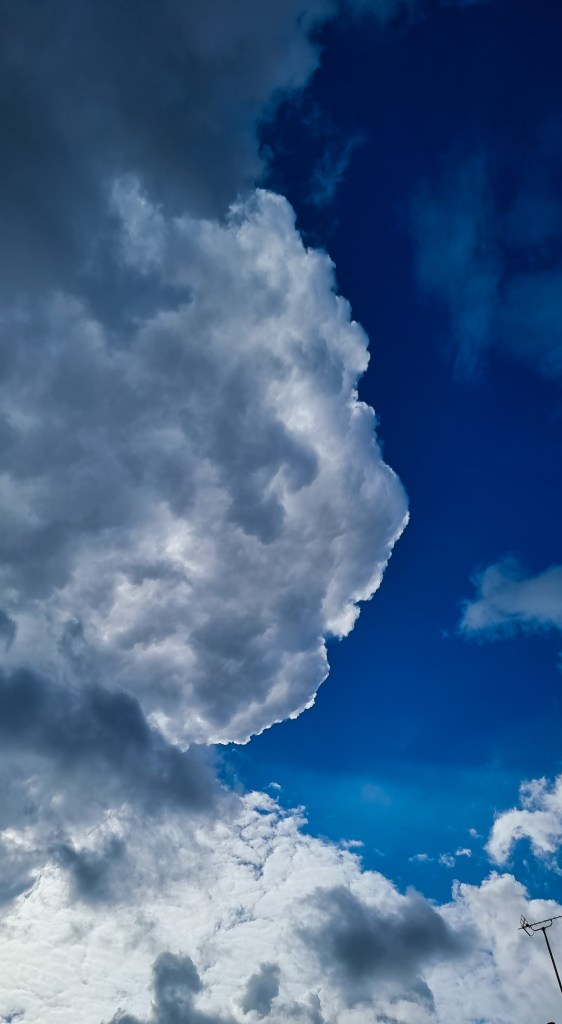
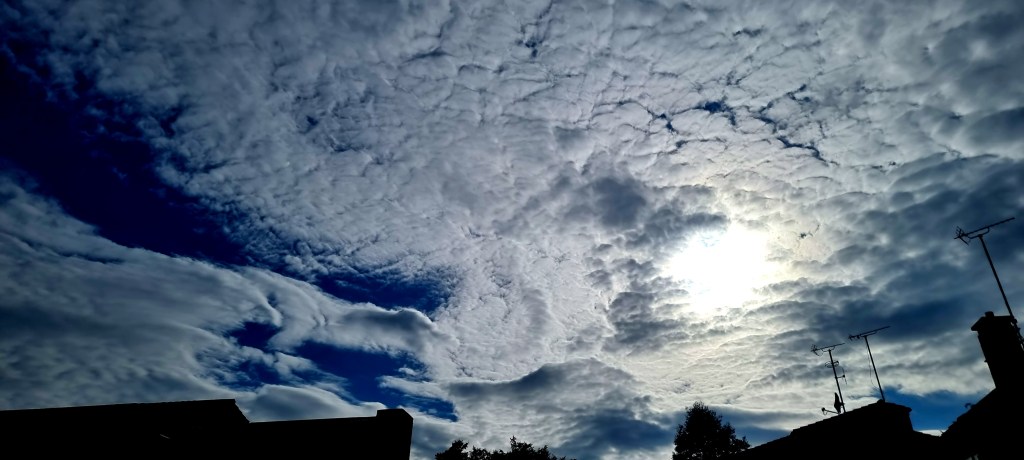
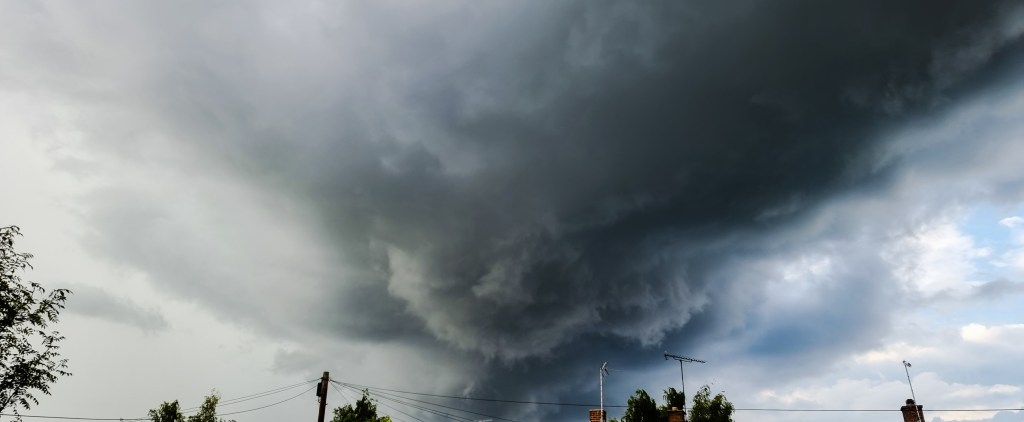
It was a changeable day for clouds today.
(c) K Wicks
Mainly because it’s a grasshopper, but only in its solitary mode. Once it activates and becomes gregarious, then it becomes a locust. I had no idea they were the same species that transforms into an eating machine and become a ‘plague’ when the conditions are right. It would seem there have been some odd occurrences in the past, recent past in the bigger scheme of things, which stand out as a bit odd. And recently having seen a number of articles about factories being built to accommodate their drive to breed crickets for consumption, got me thinking in my usual way of linking together a train of thought and seeing where it goes.
This one leads me to a very wild conspiracy theory, with nothing to go on other than a single idea. That they have no intention of us having to eat bugs at all, but that they are strategically building lots of factories for bugs for two reasons. Firstly, they could cause a devastating plague by ‘accidently’ releasing them or having an incident by which they escape, in a large enough number to cause issue to any remaining crops there are in the normal population. And secondly all those extra insects can deal with us if there happens to be lots and lots of unexpected deaths. Too much for the average services. Maybe they don’t want to keep burying people, so that will be the new way. Feed the dead to insects, and then feed the insects to the living. A very creepy food chain idea.
But there have been some notable events surrounding these insects. You may be familiar with Egypt being the host for the most famous of all, the biblical plague of locusts. Another caught my attention though, of more recent times. In the US there have a number of incidents involving the Rocky Mountain locust, which decimated crops and grew to epic proportions between 1873-1877. Oddly, it ‘just went extinct’ around 1902, just like that.
There was another locust swarm through mid-west America in 1931, which seems to be around the great depression time and was caused by the drought/dust bowl scenario they say, making the conditions perfect for the grasshoppers to morph into locusts. Displacing nearly 4 million Americans who headed towards California, it is also said that Canada experienced a similar incident that year, leading to unemployment camps being built for the men who couldn’t find jobs, but could work hard labour for a dollar a day. Someone benefitted there, as someone always inevitably does from disaster.
But I never just take anything on face value, and although it may well be as they say, I’ll also look at the other possibilities and options. And there seems to be an ulterior motive for most things being introduced these days, so I think it is correct to question it. Or as they are quite fond of telling you one thing while doing the exact opposite, so if you apply that logic, suddenly things are very different from how they first appeared.
Strange as well how one of the news reports I read, mention them just falling from the sky, seems there have been other events and odd things to look into…

(c) K Wicks

(c) K Wicks
This title really shouldn’t surprise anyone who has been paying attention. It’s coming, at first through what looked like benign offerings of technology to make life easier. Covered in Convenience, or dependence? But this is more than that, this is an intrusion into our bodies, to make us literally part of their system, no longer a consumer or mere bystander, but assimilated with it.
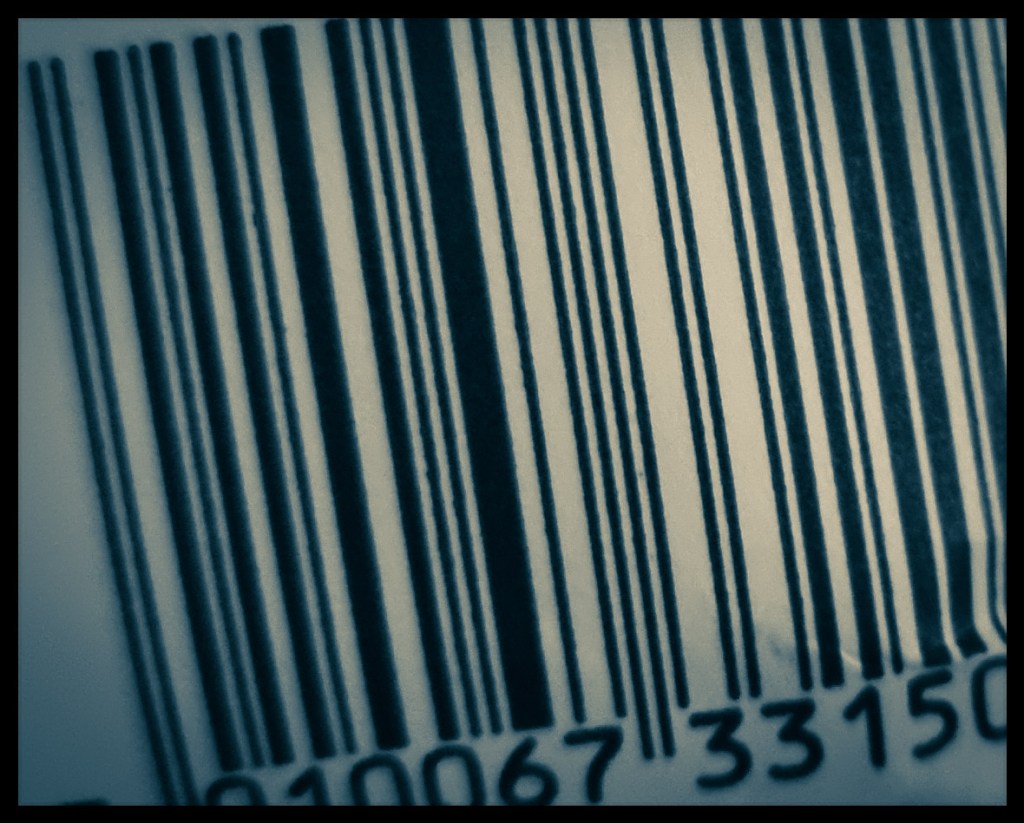
It seemed for the longest time, the barcode was the representation of the mark of the beast, as told in the bible, that no man shall buy or sell, lest he have this mark. Each product mostly has to have a barcode these days, but you can still trade without it. So, maybe money was the mark then, without that you cannot buy or sell? But you can, because you can still barter and trade with goods, eliminating the money in the transactions altogether, just like the good old days.
What they really seem intent on though, is eliminating people being part of a normal daily transactions, apart from the buying and consuming bit. A conveyor of customers that you can just scan – do you not see the correlation? They scan barcodes of products to keep track of them, and process them through a database of transactions for the purpose of analysis. Usually for the purpose of continued marketing, i.e., are people buying that product, how much do we need, re-ordering etc. So put yourself now as that product, with your inserted chip and barcode tag, slight upgrade from your national security number, although it will be tied to it, integrated with your digital ID. Once you start on that conveyor belt, you don’t actually know where it goes do you? And as they scan more people and analyse the data, they will adapt those systems for said requirement, but as the algorithm interprets them, from a robotic and sterile viewpoint. There will be minimal interaction with other people, unless they too are part of the conveyor. I know a little we’ve all secretly dreamed of having a shop to ourselves, or wishing that the people would be replaced by machines so we didn’t have to talk to anyone, or smile, or be polite, because sometimes we just aren’t feeling it. But on the flipside, how many have just popped to a shop to be able to see and be around people, when maybe you aren’t in the best place in your life. We used to joke about GP surgeries being full all the time because old people needed someone to talk to, so they would be there. Not anymore obviously, but the point being, that people need other people for the most part.
Once you are in the system though, by way of boimetrics, facial recognition and digital I.D, it will be very hard for you to be in control of your own life and make your own decisions. And maybe you struggled with those things anyway and welcome the new way that is coming, but the majority do not seem to be on board, not voluntarily anyway. So, they are trying very hard to coerce, blackmail and manipulate people into accepting their ‘access systems’, where they get to decide what, where, who and when. It can seem scary I know to be responsible for yourself, your whole life and decisions, but what is even scarier, is the thought of some else doing it all for you, throughout your entire life. The parent that just won’t let go, or ever let you leave home, and needs to know what you are doing all the time, and decides when you can and can’t do things, decides what you eat, if you can work etc. We used to call that controlling and abusive, but for some reason because it is the face of a corporation doing it, people seem fine with it. And because they want to do it to everyone, that seems ok to for many, just shocking. Behind these corporations are people, greedy manipulative people who are used to getting their own way and when they jump, they pay people to say how high. That’s who wants to be in charge of your life, and little by little they are being let in through the front door, being invited, just as a victim needs to invite a vampire into their home to give them extra powers, it seems to be the case here. So, all I can advise, is that people don’t be so willing to be a product on the conveyor of consumerism, because just as those things you used to scan were useful to you, you become useful to someone else, you just won’t know why yet…
(c) K Wicks
They’re looking to squeeze
Every last drop
Of your living soul
And they just won’t stop
It seems our lives
Have been forsaken
They will not give it
Power is taken
So before you give in
And may want to relent
It’s not run its course
And nowhere near spent
So gather your strength
For what is now right
When cometh the time
For freedom you fight
For that which you love
And do hold most dear
You’ll need a sharp focus
To look through all the fear
And see what it is
That they’re trying to hide
Work out where this goes
And then to decide
~
Which side you are really on
(c) MKW Publishing
As we know, there is much debate around this subject, and some seem to find even the idea of questioning it to be a disgrace. As if you have suddenly become Rumpelstiltksin and asked them to hand over their first-born child. I don’t think there should be a problem around having the conversation, and if someone ends up thinking I am stupid because of it, then so be it. But as we have seen of late, the establishment seem rather keen on having a certain narrative in place, and the advantages it holds. So, I will examine the flat earth or globe earth question from my point of view and what advantage it may pose to have one being believed over the other. It has been part of the historical narrative for a while now that people ‘stupidly’ believed the earth to be flat, they drew it, talked about it being so, put it in stories and it was so. But then something changed, they ‘discovered’ it wasn’t apparently around 500 BC.
So, we have a round earth now, with all the maths and maps making it all nice and neat. I wonder if they had a system of vilifying people back then if they didn’t believe it, like they did with other things they insisted people ‘believe’, with very severe punishments if you didn’t. But I figured if you decide on the answers and make sure you only teach that method and reasoning, you can easily move that thought through an academic community. I used to be amused by people getting irate about people believing one or the other, my response was always that I don’t actually mind which one it is, because I’m never going to know and it doesn’t not change what my feet are stood upon.
But I have changed that viewpoint slightly, because it may well be that I don’t mind, but it’s the why that niggles at me. Why would they want us thinking it’s round? And the opposite thought too, why would they want us to think it’s flat? Both given equal time and energy with no bias. And I have come across some very interesting theories along the way, some I think are fascinating and to me hold merit and are worthy of attention. And even though I may not agree with their entire theory, it gives me ideas about how it may have been manipulated to how we know it today. One in particular I am intrigued by is the crater earth theory / bigger earth theory.
Which theorises that we are on both a flat surface area in a crater, on a much, much bigger earth. And the other ‘craters’ are the other ‘planets’ we see and are told of being reflected onto the dome of the firmament. So, when they say they go to Mars, maybe they do, because it’s over there, not up there. Once you fall into the crater theory, there are many ideas that come from it. None provable of course, but they make sense. So, I tend to then go to the why again. Why would they want to lie?
If you knew your world was suddenly much bigger, much more amazing and far reaching, would it change how you see it? What you would do in it? Where you might like to go, if you knew it just went on and on. Still vast distances, but exploring to the ends of the realm. It would be harder to contain people if they knew and were working together to discover that. But as with much in this world, there are gatekeepers to this information and opportunity. Like if you found the fountain the youth, would you run and tell everyone about it? Or an endless bucket of money, would you share it all out continuously so everyone had enough and it’s worth appeared diminished? Or would you keep it, hold it, save it, for yourself? And this is where people and greed go hand in hand, whether it is through selfishness, or the illusion of value, I’m not sure, probably a combination though with some meanness thrown in.
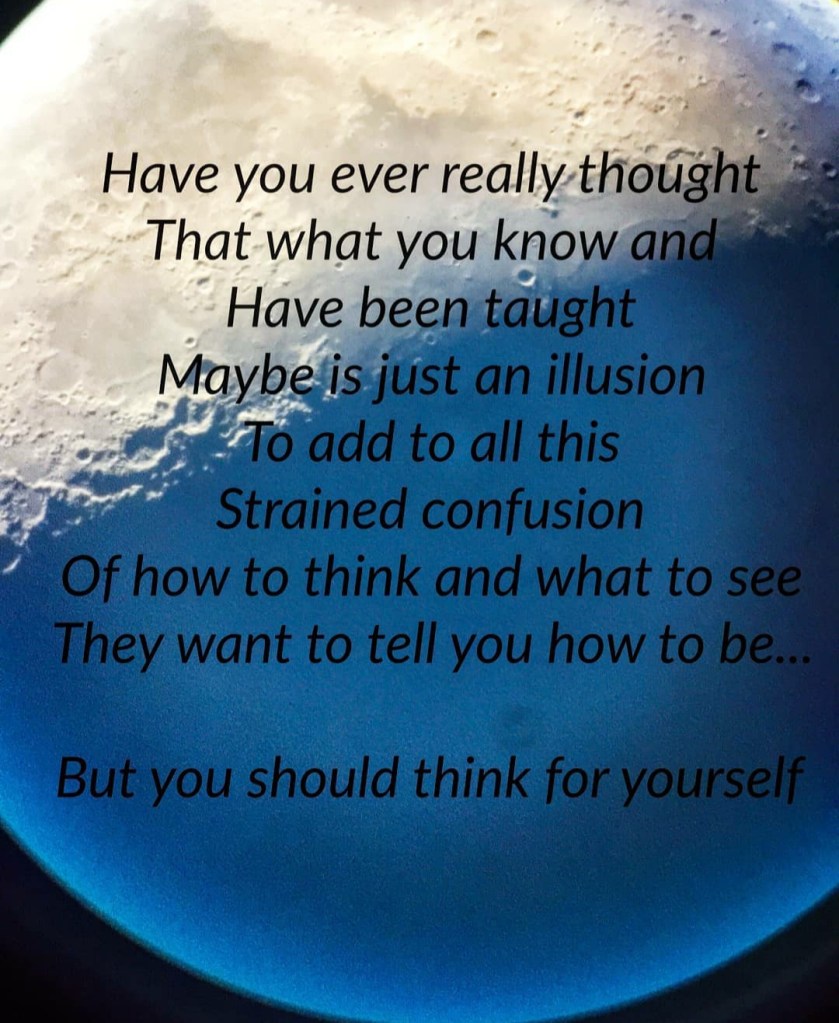
So, although the world may be one or the other, I treat it as a Schrödinger problem until I have solid information I can verify – it is both round and flat. But what I am most interested in and can unpick, is why they would want you to think something, the advantage it holds to them for us to believe we are on a precarious spinning ball, flying through space. That we should ignore the parts of physics that would dispel that, and focus on the parts that apparently neatly tie everything up, although they are subject to change or can be updated at any moment if they decide. And I am all for new information, but not just for the sake of it. It has been shown that there is much you can convince people of, and through the use of technology it is not hard to create what you want people to see, literally, so we are left to work through what is available. The things that don’t quite add up or make sense, shouldn’t be overlooked just because someone told you to, give them a bit of time and thought and come to your own conclusion, whatever that may be…
(c) K Wicks
(c) K Wicks
In the midst of this ‘energy crisis’, they feel it necessary to tell you every day you won’t be able to afford things, this and that will be cancelled, what is the most expensive appliance to run and so on.
So, I will take a look at that idea and break it down. Again, I have spent years giving thought to and researching social history and how things came to be the way they are, and indeed, how were they before. I’ll talk about obvious ones so you know what I mean.
Washing Machines and Microwaves. Both became mainstream before I was born, but were still rather pricey as I was growing up. We didn’t have a washing machine for years (or indeed a microwave), instead had to go for trips to the laundrette with my mum, getting to sit and watch all sorts of people doing their domestic chore in public. Then we had a twin-tub machine, where after it was washing, you had to hoist over the heavy wet washing into the spinner section. Then being able to rent one became a thing, and my mum rushed to get her first proper washing machine, and every week we went to the shop with the rental card to pay our instalment, sometimes just me going. Seeing how, for what looks like a little amount consistently, you can have something big. Although once I learnt of the interest charges and length of time on these things, I realised where the money was in it as a business, and it was for the people renting these appliances out.
Both washing machines and microwaves entering the household on a normal basis meant a big change to the dynamic of said household. And one I didn’t really appreciate at first, and probably not really for a long time even after I was aware. It changed time. Suddenly women, and any domestic men at the time, had more time on their hands and I didn’t realise why I hadn’t thought of it. The amount of time it used to take to complete certain manual chores was much more than today, so if you are spending all day cooking, cleaning, washing, shopping etc, that’s a whole day. But no more. You can have all that done within a couple of hours now, just by filling up a few machines and pressing a button or two. And maybe some loading/unloading. Minimal interaction and movement seem to be the point of these things. Which is great, if as a person, you have limited mobility or dexterity, but for the average person, why would you want something or someone doing everything for you if you are perfectly capable? Unless you have something else you need or want to be doing, and that is where it got interesting to me. Because it seems that people need tasks and something to do, without anything but boredom we usually find ourselves out of sorts and naturally gravitate towards self-destruction in some cases. Some are content perhaps to just sit with their thoughts on an ongoing basis, which may possibly be as inactive as they are. The majority however, would rather be doing something, with their time, energy and resources. But those three things have been commandeered and are not entirely within our control anymore.
They helped to make certain things affordable as it was cost effective to them, cut down time on the need to be in the home, more workers to join the workforce. It’s a win win for them. More industry, more taxes, more consumerism. But what of the lose lose for us? Less time with friends and family, less money because they increased the cost of things, so two incomes in a household didn’t make it any better for many. And more consumerism had led to a greedy throwaway attitude, which has unfortunately extended from the inanimate objects to people. They are now often viewed as expendable and replaceable, while constantly mentioning we will be obsolete. We were useful to build things for them that would be useful to replace us, and build better things for them.
Weirdly though, it seems we have allowed ourselves to become obsolete in this, by becoming so dependent on all the gadgets and devices they have installed into our lives, and finances. People start to forget how to do the manual things, things by hand, using your own initiative and strength.
And each of those devices have a cost, both to our sense of purpose as noted above and as purported by a certain henchman of the overlord, and there is also a cost in monetary terms. And we are seeing the finances laid bare of how much it really costs to live in their world of ‘convenience’, where that word is now being redefined too, because they are the ones who decide how much these cost, and they make vast amounts of money through it. They tied you in with meters for the electricity, hive systems now which require more batteries each year to maintain than I have ever known in my life, just to be able to adjust something from an app, which I don’t have or use. I can use my hands to turn a dial just as much as i can use them push a button, but turning the dial didn’t used to cost anything. The phones which require power and cost to run, the internet which require power and a contract, TV licenses, taxes, fees, bank charges, service subscriptions, etc.
Strip that all back, quite recently as well, and there was none of that, ‘convenience’ or cost – covered in my article There was a time before, people didn’t have each area of their daily life intruded upon in the grotesque fashion it is today, but the small implementations towards it were. And so has the social engineering to make it so. They made it so that they were your parent, caregiver and warden throughout your whole life, from ‘Cradle to Grave’ as the idea went in The Beveridge Report, as they say, all things start with good intentions. And whether it was with good intention or has been made to look that way is past the point, because this is where we are now, with the results in full swing. The idea was planted in people’s minds that they would be looked after from birth to death. It seems that post war posed a unique opportunity for a new social order, having brought everyone together under the banner of a ‘shared event’ (I will go into that further in another post).
So, I ask you, do all these devices and systems really seem that convenient after all? And what they propose for the future – further systems, log-ins, implants, chips, targets, restrictions and procedures, all dependant on electricity and you being part of the consumer conveyor belt that feeds their lives. And there is where we find we actually have a co-dependency happening, a symbiotic relationship we don’t really want, but they require. Almost like those parasitic insects that need to keep their host alive to be able to live and survive themselves. Which is why they maybe want us to think that we are so disposable, and expendable, constantly hearing news that we are ‘no longer required’ for the future, it can be done without us. Almost sounds like when someone is afraid you will leave, and they say you will never be happy without then, you’ll never cope without them, but inevitably, we always do. That does not mean we always will, but it should be noted and recognised when appropriate.
People are stronger than they know, and are more important than they realise. To minimise that existence is a cruelty in itself added to all the others heaped unnecesarily upon us. We create our own reality they say and currently are allowing that to be highjacked by the darkest type of vision. I’ve said it before and I’ll say it again, if we don’t want their cold, sterile, monitored digital prison that appears to be coming, then we better get on it and start constructing our own future reality, right now.
(c) K Wicks
 MKW Publishing