(c) K Wicks

(c) K Wicks
A cross between Ellis Island, Heathrow and Alcatraz with the general overtones of a Victorian work house. Or as we know it, Britain. It would appear that lovely green and pleasant land we were brought up to believe this was, is no longer so, and potentially was always a myth and part of the illusion. Because none of this is new, what we see around us, it’s just a ramped up out in the open version. We have had class divides, credit systems, and ways to keep people down for more than an age or two. Royalty and lords of the manor dictating and ruling, politicians and lords of the house, lining their pockets and futures at the expense of everyone else’s. Walls, fences and boundaries to keep you off their land, now even more so with corporations and institutions being the face of it, or lack of face of it rather, making it all the harder to focus on one person being the problem, they have many. Boards and committees, CEO, CFO, executives etc. Ways to dilute the responsibility or side step it altogether. Or, they will throw one of their own to the wolves, when necessary, as a show of good faith, I guess. But like the hydra, cut off one head, and there are many more to replace it. It’s like a well-oiled machine now.
But it really does seem, when you think about it, that Britain is a bit of a hub for trafficking of people. Funny really, because you would think as an island, it would be easier to control that kind of thing, and manage effectively. Which is why you realise it’s orchestrated. People are a huge commodity, and have been traded and used, for as long as we know of. I’ll use Britain as the main example as that is where I grew up, and going by what is written as accepted history, it seems we have stolen our own people as well as others, but there are British, French, German, Dutch and other European colonies all over the world. When I had learned of it all as a child, I stupidly thought it was like a magical adventure, people would have been offered new lives, free travel and an opportunity to settle and make a life in newly discovered awesome places. Not quite comprehending the sweep and clear missions to get rid of the people already there. And learning years later of what occurred to many sent to Australia, who in fact were taken from orphanages, and even lied to that their parents had died, just to have a workforce and people to condition to their way. That’s where I realise that child labour or slavery serves a purpose over adults. Children are less likely to revolt, or question things, or know how to organise. Also, easier to make them believe they are alone with no-one to help them, must have been awful for them, thinking as well they were going to start a new wonderful life, until you got there and were treated like crap. Perhaps then making for a rather downtrodden population thereafter, prone to trauma triggers because the whole society started as that. Just a theory, who knows for sure. Here is another quite stunning piece of history, which given what we know of ‘care services’ and child trafficking today, raises many questions in my mind.
“The Orphan Train Movement was a supervised welfare program that transported children from crowded Eastern cities of the United States to foster homes located largely in rural areas of the Midwest. The orphan trains operated between 1854 and 1929, relocating about 200,000 children.”
I also find it interesting that it coincides with the Industrial revolution period, and notably in my mind, a series of World’s fairs –
From Wikipedia – Industrialization (1851–1938) – The first era, the era of “industrialization”, roughly covered the years from 1850 to 1938. In these years, world expositions were largely focused on trade and displayed technological advances and inventions. World expositions were platforms for state-of-the-art science and technology from around the world. The world expositions of 1851 London, 1853 New York, 1862 London, 1876 Philadelphia, Paris 1878, 1888 Barcelona, 1889 Paris, 1891 Prague, 1893 Chicago, 1897 Brussels, 1900 Paris, 1904 St. Louis, 1915 San Francisco, and 1933–34 Chicago were notable in this respect
I wonder if some of those fairs, were also a handy way to relocate people, and buy and sell what they needed for the industrious projects. People. I’m sure it’s no secret they would acquire skilled people at these ‘events’, but there is always the side you aren’t obviously aware of, and often more than one purpose for something so grand and opulent. Many questions arise when you start to look at the details of some of them. Weird passports to get into them, workbooks, grades and numbers being assigned to the ‘guests’. Seems more like an odd training camp or university, rather than just a gathering of inventions and science of the future. Like I said, interesting.
But at the moment, it’s really not a secret, and in fact for quite some time, it looks as though people are being deliberately encouraged to come here, but not as a registered citizen by normal means that others have to follow. No, no. They want them to arrive with nothing essentially. So, why is that? So they can give them things? Or perhaps they require new citizens, and it’s easier to just sort of poach someone else’s. Often after you have ruined the area those people may need to leave from, convenient huh? But recently it seems more and more are coming from all sorts of places, and ending up here. A tiny island, often cold and wet with limited land options after all those walls and boundaries add up. Can’t be for the ordinary opportunities you or I may be thinking of. More like a Mos Eisley kind of feel to it, rather than Little House on the Prairie. So, would anyone notice if a few hundred undocumented people went missing? Or more? Who would know? It may well be that there is more than one opportunity going on, we shall see. Either way, it’s a shit storm that has been created and as usual, the people On the ground will be the pawns in it…
(c) K Wicks
(c) K Wicks
It seems that while we have been busy and industrious with farming animals, we have been subject to a similar process. That at first might not seem as obvious, but when I gave it thought, seems quite close. Keeping in mind we have different purposes for various animals, not all are food.
Some are treated to ideal conditions, for the ‘best’ meat, given the best food, looked after and prized for competition or breeding. Others are kept in crowded conditions and restricted from natural growth and development. You still get a product you make money from, just not as good, or as much. So, you need lots more of those to turn a profit. Culling when necessary, medicating and feeding as needed until you have what you want. But it all comes down to the bottom line, the profits. And as we know, corners are cut, ethics misplaced and standards vary according to requirements it seems.
Even zoos are included, and are also a good example. Where even when we try and mimic a smaller version of their natural habitat, they still aren’t quite happy or content. And are watched all the time, monitored and studied.
Now apply that to people. Different levels of society, they create the environment and put us in it, often observing the results. Built up city areas are akin to battery farms to me. Towns are like the free-range version. Country living must be like the zoos perhaps or conservation reserves, where you have more freedom and area, but still not free. Then you have the zoo keepers, the game wardens, farmers and owners, who get to decide where and when. The ones that have unlimited everything, but seem to want to tag, monitor and control each and every one of those animals. Like an obsession that has raged so far out of control, it’s turned into the ugliest monster. But as far as we know, we aren’t animals, and they aren’t different from us – they just have manoeuvred themselves to have the upper hand. You may be aware of a famous line from Animal Farm, that seems as apt now as it always did.
“All animals are equal, but some animals are more equal than others”.
That’s the ethos behind any kind of ‘equality’ they profess to be shooting for. And we are the cattle, just some are treated better than others. They claim ownership over us, in some cases take our young, decide on programs and systems for us to ‘fit into’ by whatever method or means necessary. We are used as experimental fodder for their ideas and tests, and are the weapon and victim of them. As we know you can separate certain animals from their group, and get them to perform all sorts of functions under the right ‘training and conditioning’. Laying the scene for what might appear to be a crazy, or outrageous aberration from what we call ‘the norm’, because maybe it was orchestrated to be that way. Just as they say it is quite well known that after sprinkler systems came in, firemen weren’t quite as in demand as they used to be, so some started taking to arson, to give them a purpose. And I realised that has happened with so much, which may well have started with ‘good intentions’ but once the purpose is served, no-one ever seems to just step down, as the job is no longer there. They either fight to keep what is already gone, or find ways to make sure there is a need for that, instead of adapting and taking on a new role. Many things that should have moved on, haven’t, because people want to keep milking it for as long as possible. Series that never end spring to mind, or remakes, and the never-ending franchise that you realise is stuck on a rinse and repeat cycle. Just as we are. Doomed to not only keep making the same mistakes over and over, but each time bringing in new ones, and throwing logic and reason out the window, for what seems like very little benefit.
The animals held in some kind of captivity don’t seem to be themselves, just as we aren’t, making the best of your situation because there is no other choice. Or that is what we are led to believe. Imagine, if you opened the doors to the enclosures for the animals, would they stand around and hesitate to leave, wondering where they are going to get their next meal from? Would they stay because they know no different, and familiar is better than unknown? This is where we do differ from the animals, as we apparently have far more reasoning skills and ability to analyse a situation, thinking through the outcome. And that’s where they tie us up, with worry and fear in mind, paralysing us into staying put in body. Disconnecting the two, and trying to be the guide you are supposed to have internally. They want people to be easily distracted, easily led and trusting. Looking for handouts and a pat on the back by your ‘keeper’. Waiting for their scraps and to feel like their favourite, you know, like teacher’s pet? And what is that, an animal…
(c) K Wicks
(c) K Wicks
A volcano painting, if you like that sort of thing…
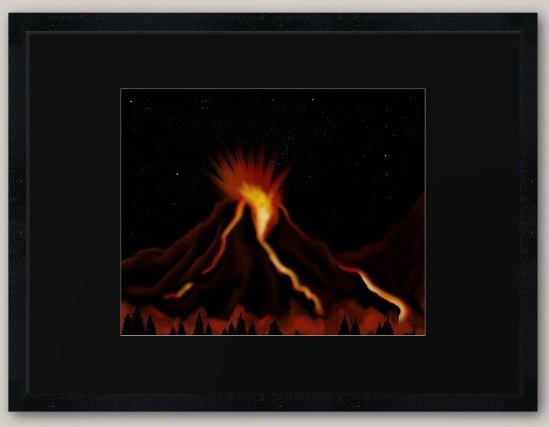
Volcano (MKW-DA.32) Framed Art Print
(c) K Wicks
It’s part of big capitalism, Christmas, and as it fast approaches, you can’t help but notice signs of it, adverts, products, Christmas lights and trees, which I must admit, love seeing. But with that comes certain pressures that have now become a tradition, as well as the merriment that used to accompany it. Over the years though, we have seen Consumerism really hit us hard around this time of year, to encourage maximum spending, often leading to debt for some. That’s when I realised years ago it was a bit of a con, seeing adverts for Christmas savings schemes, I thought it was ridiculous that people couldn’t save their own themselves and needed to save all year round for a one off ‘event’. I loved presents as much as the next kid, coveting many things throughout the year, hoping when the time came, your list of requests would magically appear on Christmas morning under the tree. Having no concept really of cost, durability, or whether it was even practical.
Then it all changed slightly, and I feel a certain catalogue contributed to this. At least in the UK anyway, the Argos catalogue. Each year, around Christmas it would be great to just flick through it, looking at all the games and toys, looking at all the things you thought you needed to have. The difference though, is that all the prices were there, giving a vague sense of value, by listing the cost for all to see, including the children. I know some completely overlook it, and if you are trying to negotiate for a particular toy or present, should imagine it’s quite important. Because someone has to pay for it, either by using hard earned money, or borrowing, and paying it back. On the glad and sorry it used to be called. Glad you had it, sorry you have to pay for it. And as I got older, that’s how I saw it, and made it so that if I couldn’t afford it, I couldn’t have it. Debt isn’t a happy situation, as I am sure many know, so I decided that it definitely wasn’t a scenario I would create for myself, just for Christmas.
So, Santa Claus or Sinterklaas, story taken from a saint eighteen hundred years ago or so, and given a marketing makeover in the 1840’s. Apparently by way of a poem, and then Santa as we know him today in his red suit and with a big white beard was added in by an artist.
“This image has been maintained and reinforced through song, radio, television, children’s books, family Christmas traditions, films, and advertising.”
It seems that there is also a companion to Santa, one they couldn’t get rid of in folklore so it’s been incorporated. Or was that the true story, and they twisted it so it wouldn’t appear as it was. Quite dark and creepy. I’m talking of Krampus, recently having a slight revival with movies and television, but that was who dealt with the naughty children, with his horns, cloven hooves and a rather devilish appearance, but often with a black or brown colour. Sounds like two sides of the same coin, split to make them seem like good cop, bad cop. One looks like the devil, the other dresses in red. Make of that what you will. And being honest, Santa himself (as many have pointed out along the way is an anagram of Satan), is a bit of a creepy concept, with the idea being that while you and your family sleep, a stranger sneaks silently into your house and leaves gifts for children (or kidnaps and tortures the naughty ones, see Krampus tales for that, who also sounds very much like the child snatcher from Chitty Chitty Bang Bang). Sounds awfully like stranger danger and a bit of grooming there! And it is grooming of sorts, just by companies and corporations, to perpetuate the myth and tale using the parents as a conduit, to back-up the continued consumer industry that demands your allegiance, for life it seems. Start them young as they say.
They also appear to have thought of an angle towards resistance to this mega marketing machine, with a jokey surface and serious implications to anyone who doesn’t get on board with the routine, or are lacking in what they dubbed ‘Christmas spirit’. I’ll use the two examples that spring to mind.
The Grinch – thoroughly marketed and revived, through cartoon, film and books, most people know the story. But no worries, because he comes good at the end, realising how great Christmas was after all. You might notice that as a theme here.
Ebeneezer Scrooge – the serious tale of a grumpy old miser who after some shocking experiences induced by three ghosts, suddenly sees the error of his ways, and indulges in Christmas from that point on. I feel these two characters also make it easy for people to ridicule people who don’t want to engage in the superficial side of it, or who just simply aren’t interested. You get called scrooge, or that you are being grinchy. Not by accident I feel.
Nightmare before Christmas – a favourite of mine, and is slightly different but relevant I feel. The king of Halloween is bored with his yearly routine, and while out wandering, falls into Christmas Land. Where the feeling of glee and joy brought him a great and overwhelming feeling himself. So, long story short, he steals Christmas by kidnapping Santa, and goes about delivering Halloween style presents for Christmas. I do recommend it, as it’s quite an interesting film all round. But in trying to replace Christmas, it becomes dark and ruined, and apparently only Santa is the one who can restore this. And, the snow. Quite pivotal it turns out. But joy prevails when Christmas can be had, as is reinforced time and time again.
And in the last couple of years though, this seasonal holiday has been wielded as a point of ransom a few times, over lockdowns, now over strikes and financial catastrophe. Because lots of people use the time to visit friends and family, have Christmas parties (as we may remember the politicians getting on with), or people just like to treat themselves or enjoy having some time off. All made harder and, in some cases, no-existent this year, and possibly thereafter. So, although I don’t agree with the spending furore that surrounds this time of year, I do agree with the sentiment of family, friends, making gifts and getting through the dark and cold winter days. Aint nothing wrong with that.
(c) K Wicks
(c) K Wicks
We see it a lot these days, an entitled attitude from people, and to be fair it was always there, just not so obvious for a time, sort of. Because we have different levels of it, just as we have a class system, and ‘levels of society’. And let’s be honest, it starts from the top down. We have one family at the helm of our country, who ‘rule’ us, so I believe it begins there, going down through the levels until we see it has filtered through to most areas.
People think they are entitled to things, but let’s look at why that is. The definition of it being as follows –
“Entitlement – believing oneself to be inherently deserving of privileges or special treatment”.
And we’ve heard the word privilege enough recently with it being tacked on to a certain people of a pale complexion. But why is that? I always thought I was privileged to have been born and brought up in the UK, realising geographical location plays a massive part of who you end up being. Certain freedoms and opportunities didn’t seem as available for others, so I took that as being privileged. But there are others who have more, and less, on this same island. So, there are grades of privilege once you look beyond the personal aspect. Having a certain surname, or attending particular schools will afford you certain privileges, regardless of your character it would appear. So, I totally understand why people who are told they are privileged because they are white, may laugh a bit, and debate the point. The ‘working class’ have always been looked down on by what they call ‘higher orders’ of society in this country. Which is why it’s slightly bemusing that people try so hard to get elevated to those ‘upper ranks’. Where I guess you too become privileged and can then look down on others? Because it wouldn’t be to help others now, would it? Or that’s what they’ll say until they get there it seems.
But not many start at the bottom, genuinely at the bottom, and work their way up to any position of importance. The ones who are selected, under the pretext of being elected, start a foot or two ahead of others, and often then puts measures in place to ensure others get to go one step forward and two steps back. So where does this implied and followed set of hierarchical privileges stem from? And where does the apparent entitlement to them come in and how has it continued for so long? Now we see a general sense of entitlement has been filtered down to the normal folk of society. Is this so they can add more layers to the privilege cake? So that people will overlook the failings and ineptitude of those ‘privileged elite’ because you think you can get a step up near to it? I wonder.
But why do so many people think they are entitled? Because they have been told they are, without really questioning or understanding it perhaps. Missing the benefit to the ‘privileged elite’ of you believing you are entitled and acting as such. Making demands, waiting for your leg up or hand out, and casually falling for their trap. Because the system is rigged and we are all set up to fail unless you are already in the club. It just needs to look like an unknown makes it, or a rags to riches story to warm the heart and fuel the dreams they want you be distracted with. Or at least that’s how it appears on the ground when you really start to pull the thread. So tidy and neat on the face of it, but then a few holes, a couple of loose ends, and things that just don’t add up if you look beyond the smooth frontage of it all.
So, it suits their purpose for us to be stepping on each other, and scrabbling to get the bigger crumb they thrown down every now and then. Wanting you to want to be the crumb thrower, and not part of ‘the rabble’ pushing and shoving for crumbs. And while that occurs, they can breeze through and make their changes and adjustments to the world around you. And if you notice and start to have a problem with it, they tell you it’s you, you’re the problem. Or find a way to rid themselves of that problem, or to program it out of people using laws, rules, medications, education etc.
They can never really quite factor in all the variables though. Despite the determined consistencies, there will always be the ‘rogue element’ that persists in disrupting the perceived outcome.
Be the rogue element, not a determined consistency.
(c) K Wicks
I had already speculated on the ‘opportunity’ a shared event creates and used films to illustrate my point – one article being Films, real life twisted or just fantasy? . I’ll do so again here though, because many don’t seem to realise what kind of power that has, in the collective psyche of people, and how it can be used to further mould and shape society.
The Island (2005) – a stark view of something that is discussed in my piece Perhaps, where people are bred as replacement organs for rich people, but they are kept underground with no knowledge of the real world or their true purpose. Instead, they ‘imprint’ them and condition them to believe that there was a catastrophe, a virus in fact. And the world outside is so toxic, they have to stay down there, hoping one day to win their ‘lottery’ and go to a pathogen free island where ‘you can live a normal life’. The whole society functions on that premise, until someone starts questioning things, as is the way. But I found it interested how the overseer (Sean Bean in this film), had quite a well-developed God complex going on, and took great delight in explaining how they were bred to believe they were special and only educated to the level of a 15 year old, which seemed to keep them in line for the most part. Seems a bit like how we are treated don’t you think? Or is it just me that sees it?
Book of Eli – this is a great film, well done, atmospheric, gritty. And is about a disaster happening, although it is a vague briefly mentioned ‘event’ that was a bright flash, which blinded lots of people, and then everything went to shit. We step into the story after 30 years has elapsed, and it’s worth a watch. Even just for Gary Oldman’s brilliant portrayal of someone obsessed with finding a bible. Because with that, he knows he can control people, even more so that shown. Because what we are led to believe is, if everything did go to shit, or there was a real danger to behold, that we would all scatter and try and save ourselves with no thought for humanity. Apart from maybe one or two lone ‘heroes’ to save the day or give hope. The film The Road would be an even more desolate and grim look at what they would like to think people would turn into. I don’t doubt the capability, but I question the continued conditions that would be necessary to create such a landscape.
There are a few films I will mention together here as they have something similar to me – Resident Evil, Greenland, The Day after Tomorrow, 2012, Outbreak, Deep Impact – and I guess any of the films that have ‘natural disaster’ or virus as the headlining event, with huge amounts of drama unfolding, survivors and a new horizon often at the end, not always a good one, as Resident evil showed, in a never-ending cycle of rinse and repeat. They like that method, and to be honest, if it works, why not. Gets a bit boring though if you happen to notice it. In real life and films.
If people have been exposed to the same information, education, propaganda, media and conditioning, it makes it much easier to make that group accept something, or act in the way you would like with the correct triggers, if you can get most people on board. And anyone not playing ball, gets pushed out, excluded, or shouted down. It also helps people to feel familiar with each other, gives them a social bond and sort of identity in that place and time by ‘experiencing’ an event.
But there will now be a ‘shared collective experience’ that seems so useful a tool in many a movie. And helpful to separate again
Dark City – is a film I mention time and time again, if you haven’t watched it, I recommend it. But this movie is the inverted version of the above, where the do the opposite to people. Give them no shared history, or events, or place in time, and tampering with their memories and identities, leading to lost and rather robotic people. Until one person ‘wakes up’ during a memory procedure, and has to unravel the very odd set up and ‘people’ organising it all.
So, what happens I wondered, if you merge the two. Creating a shared event that we are all bound by, but with no real timeline or end so no closure to move forward from. This could cause a possible destabilisation of being trapped in the same event continuously, without said event actually continuing to occur. And with details being changed, definitions rewritten it’s easy to see how some people might get confused, and start to feel a bit lost. Changing names, rules, areas, time, thoughts, futures and people. It all has a purpose, even if you can’t see it yet, it all paves the way for something else.
(c) K Wicks
 MKW Publishing